

Roundups and Guides
How to organize family recipes before they are lost
A family recipe is a method plus a story, and the story disappears first. Here is how to capture both while the people who remember them are still around to ask.
The recipe usually survives. What disappears is everything around it: who made it, when it appeared on the table, and what "cook until it looks right" meant to the person who wrote it.
This guide is a preservation plan. It covers who to ask first, how to record the story alongside the method, how to photograph fragile paper, and how to translate instructions written for a kitchen nobody uses any more.
What does organising family recipes involve?
Organising family recipes means capturing 3 things for every dish: the method, an image of the original document, and the provenance — who cooked it, for whom and on what occasions. A transcription alone preserves the food and loses the family.
Treat provenance as a required field rather than a nice extra. It is the part that cannot be reconstructed later from the internet, and it is the reason anyone in the next generation will open the collection at all.
The work also has an order that matters. Recipes held only in someone's memory are the most fragile, loose paper is next, and anything printed in a book can be found again. Spend your first weekend on the fragile end.
Who should you interview first?
Start with the oldest cook in the family, not the tidiest recipe box. Paper waits; memory does not, and the recipes that exist only in someone's hands are the ones with no backup at all.
- 1Ask what they cooked for occasions, since celebration dishes are remembered in more detail than weeknight ones.
- 2Ask who taught them. You will collect a second generation of recipes and names in the same conversation.
- 3Record the audio on your phone with permission, so you keep the phrasing rather than your paraphrase of it.
- 4Cook one dish together if you can. Half of what they know only surfaces with their hands in the bowl.
- 5Photograph anything paper on the day, even if you have no plan yet for organising it.
One conversation of 40 minutes usually yields 5 or 6 recipes and a dozen corrections to recipes you thought you already had. Book a second visit before you leave the first.
Go in with 3 named dishes rather than an open question. "Tell me about your cooking" produces politeness, while "how did you make the Sunday pudding" produces measurements, arguments and a story about a broken oven in 1982.
How do you capture the story with the method?
Write the story into the recipe entry itself, in a notes field that travels with the ingredients. A separate document about the family always drifts away from the recipes it explains.
- Who and when: "Nan, made every Christmas Eve from the 1970s until 2011."
- Where it came from: the neighbour, the village, the back of a flour packet, the job in a hotel kitchen.
- What it was served with, which is often the missing half of the meal.
- The disagreements: every family has a dish 2 relatives make differently, and both versions deserve saving.
- Your own note after cooking it, since your reading of the method is now part of its history.
Keep the words as they were said. "You want it wobbly, not set" is more useful than a temperature you invented to sound precise, and it sounds like the person who said it.
Add one photograph of the dish itself the first time you cook it. A finished plate tells the next cook what they are aiming for far faster than a paragraph of description, and it dates your attempt.
How should you photograph the original card?
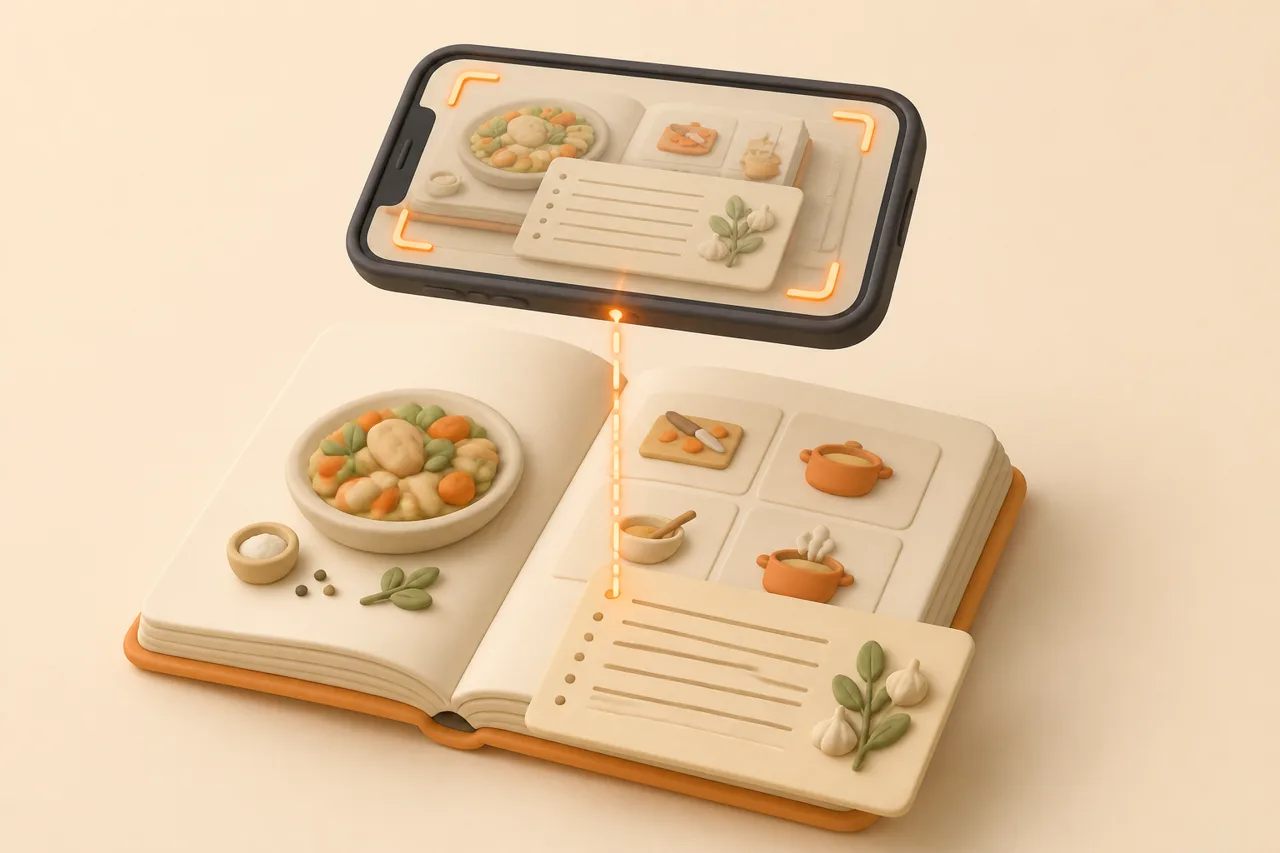
Photograph every original flat, in daylight, before you transcribe anything. The handwriting, the splashes and the crossings-out are part of the record, and a good photo also lets text extraction do most of the typing for you.
- 1Work near a window, not under a lamp
Indirect daylight avoids the yellow cast and the hard shadow that make old ink hard to read.
- 2Flatten the card, do not hold it
Put it on a plain dark surface and weigh down the corners. A curled card blurs at the edges where the faded writing usually is.
- 3Shoot straight down, filling the frame
Square to the card, close enough that the writing fills the picture. Angled photos confuse text extraction more than dim light does.
- 4Capture both sides and the box
Backs of cards carry variations and dates. A photo of the box or tin gives the collection its cover image later.
- 5Import the photo into a recipe app
OCR reads the text into an editable recipe, and ReciBites keeps that alongside imports from cookbook pages and websites so the family dishes live in the same library as everything else.
Photograph in batches of about 20 and check the extracted text in the same sitting. Leaving 200 unchecked photos in a camera roll recreates the shoebox in digital form, which is the outcome the whole project exists to avoid.
Expect to correct handwriting that even relatives argue about. The card-by-card mechanics are covered in digitising handwritten recipe cards, and bound books need a different technique, set out in scanning a cookbook.
How do you decode vague heirloom instructions?
Translate old measures into modern ones, but keep the original wording in the recipe as well. The vague phrase is evidence; your translation is a working guess, and labelling them differently saves an argument later.
| Written on the card | Usually means | How to confirm |
|---|---|---|
| A moderate oven | Around 180C or 350F | Cook it once and note the setting that worked |
| Butter the size of an egg | Roughly 50g | Weigh what you actually used |
| A teacup of flour | About 120g, though cups varied | Ask which cup, then weigh that cup |
| Cook until done | A visual or texture cue | Ask what it should look like, not how long |
| A knob, a glug, a handful | A ratio rather than a quantity | Cook alongside the person once |
Where nobody remembers, cook the dish twice and write down which attempt was right. A tested guess beats a faithful transcription you cannot follow.
Watch for ingredients that have changed rather than measures that are vague. Flour, stock cubes and cream are not what they were 50 years ago, so a recipe that fails on the first attempt is often accurate and simply describing a different pantry.
How do you share the collection with the family?
Share it early and in a form other people can add to, or you become the single point of failure you were trying to remove. A collection one person owns on one phone has the same fragility as the shoebox.
- Give everyone read access first, so relatives can correct what you got wrong.
- Invite 2 people who can add, ideally from different branches of the family.
- Export a copy each year and send it round, so several households hold the archive.
- Keep the physical originals with one person and photographs with everyone.
- Print a small book of the 20 dishes people actually cook, for the relatives who will never install an app.
Sharing also recruits help. Once relatives can see the collection, corrections and missing recipes arrive without you chasing them, and an aunt who would never start an archive will happily fix one.
The durability question deserves its own pass, and backing up your recipes covers exports and the 3-2-1 approach in detail.
What order should you work in?
Work in order of what is most likely to be lost, not what is easiest to scan. That sequence is people, then loose paper, then books, then anything already digital.
Choose tooling that suits the shape of the job. A paper-first archive is the whole purpose of ReciBites vs OrganizEat, while a shelf of inherited books is better served by ReciBites vs Cookbook Manager.
If the recipe box is your main project rather than one part of it, the migration plan in switching from recipe cards gives you a realistic batching schedule for the paper. Whichever tool you pick, the test is whether a relative could find their own dish in it without your help, because a collection only you can navigate is an archive of one.
Frequently asked questions
+How do I preserve my family recipes?
Record the cook first, photograph every original card flat in daylight, then store the method, the photo and the story together in one shared collection.
+What should I ask a relative about a recipe?
Who taught them, when they cooked it, what it was served with, and what it should look like when done. Record the audio rather than paraphrasing.
+How do I read faded handwriting on old recipe cards?
Photograph the card flat in indirect daylight and let text extraction attempt it, then check the result against a relative. Keep the photo either way.
+What does a moderate oven mean in an old recipe?
Usually around 180C or 350F. Cook the dish once, note the setting that worked in your oven, and save that alongside the original wording.
+Should I throw away the original recipe cards?
No. Keep the paper after digitising it. The handwriting is part of what you are preserving, and photographs are a copy rather than a replacement.
+How do I share family recipes with everyone?
Give relatives read access to the collection, let 2 of them add recipes, and send an exported copy round each year so several households hold it.
+What if two relatives make the same dish differently?
Save both versions as separate recipes with the cook's name in the title. The difference is family history, not an error to resolve.
+How long does digitising a recipe box take?
Photographing is quick; checking is not. Budget a couple of minutes per card for corrections, and start with the 10 dishes the family actually cooks.
- #family recipes
- #preservation
- #handwritten
- #ocr