

AI and Smart Kitchen
AI recipe generator vs recipe organizer: which do you need?
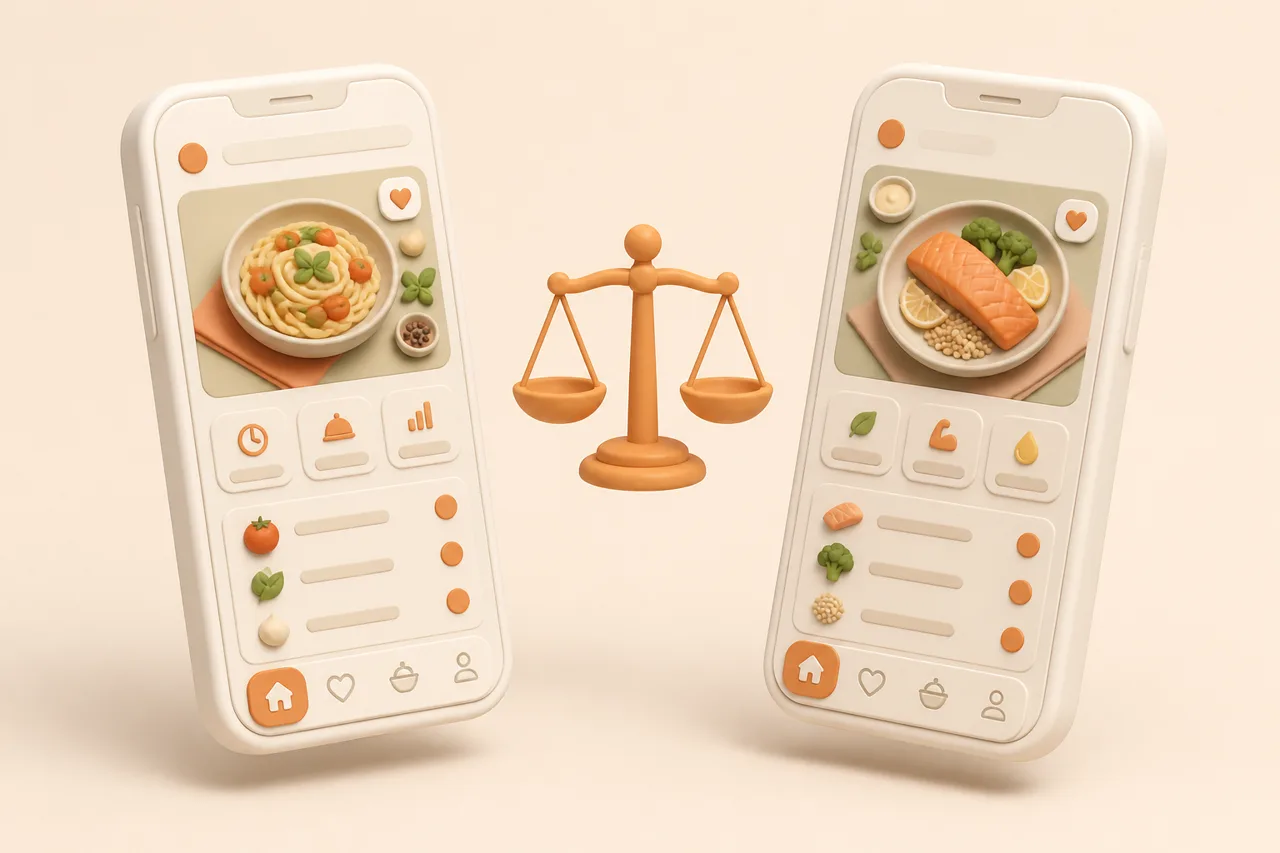
One tool writes recipes that never existed. The other keeps the recipes you already trust. Confusing them is why people end up with 400 saved links and nothing to cook.
Two very different products get sold with the same three letters in front of them. One invents a recipe that has never been cooked by anybody. The other takes the recipe you found, pulls it apart into ingredients and steps, and files it where you can find it again.
Choosing wrong is expensive in a quiet way. You subscribe to an idea machine while your actual problem is 400 unsorted saves, or you file recipes beautifully while wanting something new for Thursday. This article sorts the two categories and gives you a decision rule.
What is the difference between an AI recipe generator and a recipe organizer?
An AI recipe generator produces a new recipe from a text prompt, while a recipe organizer imports and structures recipes that already exist so you can search, plan and shop from them. The generator creates content; the organizer manages content you selected.
The distinction decides everything downstream: where the recipe came from, whether anyone ever cooked it, and what happens when the tool is wrong. A generator that hallucinates gives you a dinner that does not work. An organizer that misreads gives you a typo you can spot against the original source.
Marketing blurs the line because both use the word AI. A useful test is to ask where a recipe in the app came from. If the honest answer is a model, you are holding a generator, and if it is a creator, a blog or your grandmother's card, you are holding an organizer such as an AI recipe organizer.
How does an AI recipe generator work?
A generator turns your prompt into plausible recipe text using a language model trained on cooking writing. You ask for a 30-minute vegetarian dinner with halloumi, and it composes ingredients, quantities and method that read like a recipe from a food blog.
Nothing in that process cooks anything. The output is a statistical picture of what a halloumi recipe usually looks like, which is often good enough for a stir fry and often not good enough for pastry.
- Strong at: ideas, flavour pairings, using up an awkward ingredient, restyling a dish you already know.
- Weak at: exact ratios in baking, fermentation and preserving, cooking times for large cuts, anything where being wrong is a health issue.
- Unverifiable: you cannot check a generated recipe against a source, because there is no source.
How does a recipe organizer work?
An organizer imports a recipe from a link, a video or a photo and converts it into structured fields: title, quantified ingredients, ordered steps, servings and the original source. AI does the extraction work, but the recipe itself is one a human wrote and other people cooked.
That is why an organizer feels less magical and gets used more. It solves the problem most cooks actually have, described in why saved recipes get lost, which is retrieval rather than inspiration.
- Everything in the library is traceable to a creator, blog, cookbook or handwritten card.
- Search works on ingredients and tags, so Tuesday's decision takes 30 seconds.
- Planned recipes roll into one grocery list with duplicate ingredients merged.
- The library survives platform changes, because your copy is text rather than a bookmark.
What are the failure modes of each?
The two categories fail in opposite directions, and the difference matters more than any feature list. One risks being confidently wrong, the other risks being merely incomplete.
Where generators go wrong
Generated recipes are untested by definition, so errors arrive dressed as instructions. Treat the output as a draft written by a keen but unsupervised assistant.
- Ratio drift. Baking formulas can come back with too much liquid or leavening, which you only discover after the bake.
- Confident food-safety errors. Timings and temperatures for poultry, canning, curing or reheating rice should never be taken from generated text unchecked.
- Allergy substitutions that do not hold. A swap can be nutritionally plausible and functionally wrong, or miss a hidden source of the allergen entirely.
- No repeatability. Ask twice, get two different recipes, so a dish you liked can be hard to reproduce unless you saved it.
Where organizers go wrong
Organizers fail quietly by giving you back exactly what you put in. A bad recipe imported cleanly is still a bad recipe.
- Extraction slips. Vague amounts such as a glug or a handful arrive vague, which is covered in AI extraction accuracy.
- Garbage in, garbage filed. No tool can tell you the recipe you saved was never any good.
- Library rot. 600 imports with no tags is the old problem in a new app.
- No new ideas. An organizer will not tell you what to do with 3 courgettes and a tin of butter beans unless you saved something using them.
How do the two compare side by side?
Read this table by column, not row. The right answer changes with how often you cook and where your recipes come from.
| Dimension | AI recipe generator | Recipe organizer |
|---|---|---|
| Source of the recipe | Invented from a prompt | Imported from a link, video, photo or card |
| Has anyone cooked it | No | Usually yes, by the creator and their audience |
| Best question it answers | What could I make? | What did I save, and what do I cook this week? |
| Failure mode | Confidently wrong instructions | Incomplete or unsorted library |
| Verification needed | Every time, especially quantities and safety | A 10-second check against the original |
| Grocery list value | Only for the single generated dish | Merged across a full week of planned meals |
| Gets better with use | Marginally, through better prompts | Yes, the library compounds |
| Works offline in the kitchen | Rarely | Usually, once recipes are saved |
Which one should you pick?
Pick based on which sentence describes your last frustrating evening. The framework below fits almost every household.
- 1Pick a generator if you cook confidently, improvise happily and want ideas rather than instructions.
- 2Pick an organizer if you already have saved recipes across TikTok, Instagram, browser tabs and screenshots.
- 3Pick an organizer if you cook for a family, because repeatable meals beat novel ones on a Wednesday.
- 4Pick an organizer if anyone in the house has an allergy or a strict diet, and a traceable source matters.
- 5Pick both if your real gap is the blank-page moment on Sunday, and you want ideas that land in a real library.
Run that count honestly before you subscribe to anything. Most people who describe themselves as short of ideas are actually short of a way to see the ideas they already collected.
Can you use both together?
Yes, and the sensible order is organizer first, generation on top. Build a library of recipes you trust, then use AI to adapt those recipes rather than invent replacements for them.
- 1Import the recipes you already cook, so the library starts with proven dishes rather than an empty screen.
- 2Use generation only for the gaps, such as a side dish for an ingredient you rarely buy.
- 3Cook the generated version once, fix what was wrong, then save your corrected copy.
- 4Keep the corrected copy in the same library as everything else, so the good ideas survive and the bad ones do not repeat.
ReciBites sits on the organizer side. It saves recipes from TikTok, Instagram, YouTube, Facebook, Pinterest and any website URL, reads screenshots, cookbook photos and handwritten cards with OCR, then builds weekly meal plans and aisle-grouped grocery lists from what you saved.
- The AI cooking assistant adapts saved recipes for halal, vegan, gluten-free and allergy needs.
- Leftover suggestions work from your fridge contents against recipes already in your library.
- Servings scale and measurements convert inside the recipe, not in a separate calculator.
- Weekly plans generate automatically, which is the topic of AI meal planning.
Which apps sit on each side?
Compare an app against the axis it leads with, not its marketing page. Three comparisons cover the range.
- Generation-led: see ReciBites vs Flavorish for an AI-generation approach next to an organiser.
- Organiser with no AI: see ReciBites vs Paprika, a manual, file-it-yourself library.
- Social-import organiser: see ReciBites vs ReciMe for video-first saving.
- Wider field: the shortlists in best recipe organizer apps split the same way.
- Generative recipe
- A recipe composed by a language model from a prompt, with no cook, kitchen or test behind it.
- Recipe extraction
- Reading an existing recipe out of a page, video or photo and storing ingredients and steps as separate fields.
- Hallucination
- Model output that reads as fact but is invented, such as a bake time that was never tested.
- Ingredient merging
- Combining the same ingredient across several planned recipes into one grocery line with a summed quantity.
Frequently asked questions
+What is the difference between an AI recipe generator and a recipe organizer?
A generator invents a new recipe from your prompt. An organizer imports recipes you found and structures them into searchable ingredients and steps you can plan and shop from.
+Are AI-generated recipes safe to cook?
Usually for simple savoury cooking, but the text is untested. Check quantities, and never rely on generated timings for poultry, preserving, canning or reheating rice.
+Do I need both an AI recipe generator and an organizer?
Most people do not. Start with an organizer if you already have saved recipes, and add generation only if your genuine problem is running out of ideas.
+Can an AI recipe app invent a recipe that does not work?
Yes. Generated recipes can carry wrong ratios or missing steps, which shows up most in baking, doughs and emulsions where proportions decide the outcome.
+Is ReciBites a recipe generator?
No. ReciBites is a recipe organizer. It saves recipes you chose from social apps, websites, screenshots and cookbook photos, then plans meals and builds grocery lists from them.
+Which is better for meal planning?
An organizer. Planning needs repeatable recipes with reliable ingredient lists so a week of meals can merge into one grocery list.
+Can an organizer suggest what to cook tonight?
Yes, from your own library. ReciBites suggests recipes based on leftover fridge ingredients, so suggestions come from recipes you already chose.
+Do generated recipes get better if I write better prompts?
Somewhat. Naming your equipment, pan size and target cook time helps. It does not make the result tested, so a human check still applies.
- #ai recipes
- #recipe organizer
- #comparison
- #meal planning