

AI and Smart Kitchen
How accurate is AI recipe extraction in 2026?
Import accuracy depends almost entirely on where the recipe came from. Here is what holds up by source type, what still breaks, and how to check an import in 20 seconds.
Every recipe app now claims to import from anywhere. The honest answer to how well that works is that accuracy is decided by the source you paste in, not by the badge on the app, and the gap between the best and worst source is enormous.
This article breaks accuracy down by source type, explains the invisible thing that makes some web pages import perfectly, and gives you a verification checklist short enough to actually use.
What is AI recipe extraction?
AI recipe extraction is the process of reading an unstructured source such as a web page, video or photo and writing out the recipe as separate machine-readable fields: title, ingredients with quantities, ordered steps, cook time and servings. The output is data, not a copy of the page.
Three technologies do the work in sequence. A parser reads structured markup where it exists, optical character recognition converts images of text into characters, and a language model resolves the messy remainder into fields. Accuracy is the product of all three, so the weakest link sets the result.
That sequence explains why the same app can feel flawless on one link and clumsy on the next. A page carrying clean markup skips the guessing stage entirely, while a video forces every stage to run on the noisiest possible input.
What is recipe schema, and why does it decide accuracy?
Recipe schema is a block of JSON-LD markup that many food sites embed in their page source, describing the recipe in a standard vocabulary from schema.org. It exists so that search engines can show cook times and star ratings, and importers get the benefit for free.
When the markup is present, an importer reads named fields such as recipeIngredient, recipeInstructions, cookTime and recipeYield rather than guessing from paragraphs. Nothing is inferred, so nothing is invented.
- Schema present: the ingredient list arrives exactly as the author typed it, in order, with quantities intact.
- Schema absent: the importer falls back on layout and language, which is where a stray note or a headline becomes an ingredient.
- Schema partly filled: common on older sites, where ingredients are marked up but the method is plain HTML.
Most recipe blogs run a plugin that emits this markup, which is why the 2,000-word preamble does not affect the import at all. Details of the browser-to-library route are in save recipes from websites.
How accurate is extraction by source type?
Rank your sources before you judge an app. The table below describes what each source reliably produces and where it needs your eyes.
| Source | Reliability | Usual failure | Check time |
|---|---|---|---|
| Web page with recipe schema | Near-perfect for ingredients, steps, times | Rare. Occasionally a serving note lands in the title | 5 seconds |
| Web page without schema | Good for ingredients, variable for steps | Intro text or a tip box merged into the method | 15 seconds |
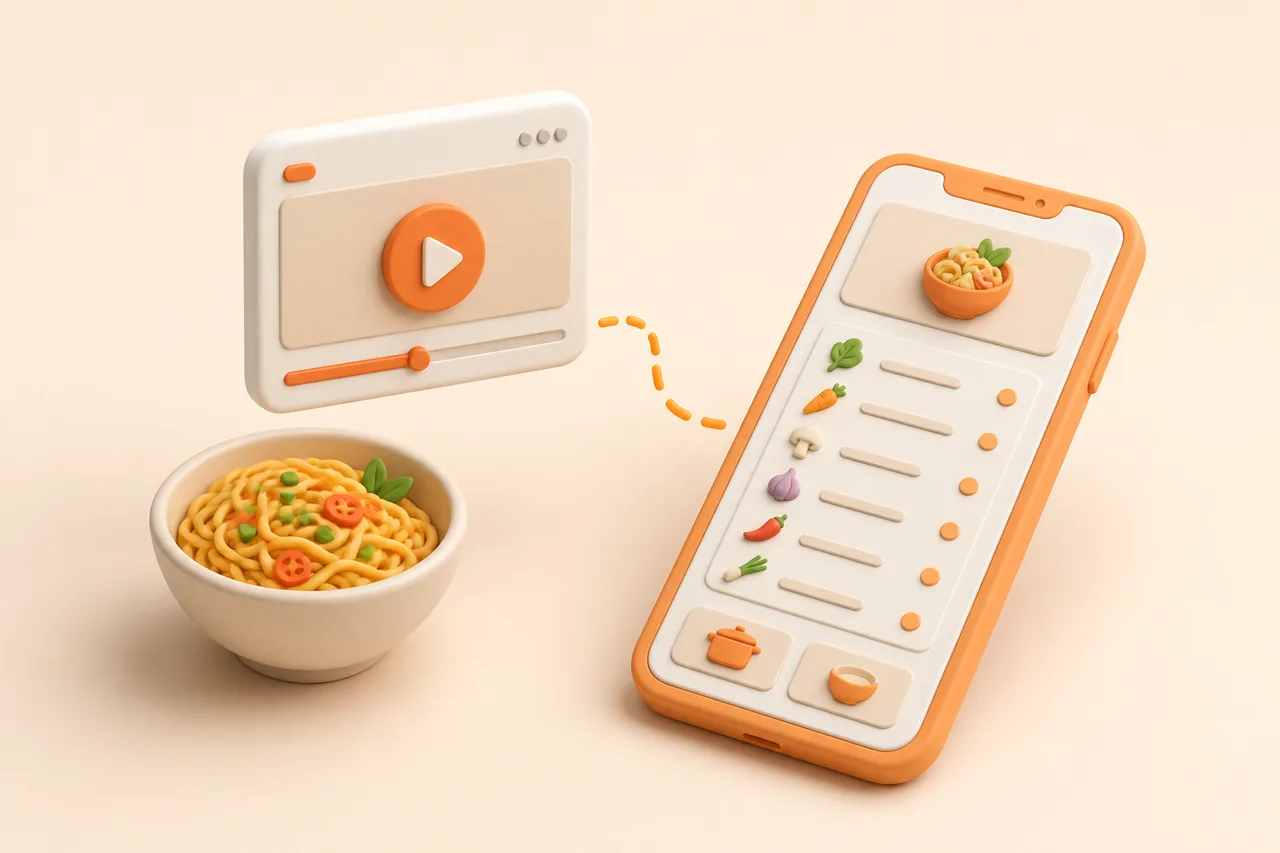
| Video with clear spoken quantities | Good for names, order and timings | Amounts said as a glug or a handful | 20 seconds |
| Video with on-screen text only | Good where text is high contrast and on screen long enough | Fast cuts, decorative fonts, text over busy footage | 30 seconds |
| Screenshot of a recipe | Strong for typed text | Cropped edges losing the last ingredient | 15 seconds |
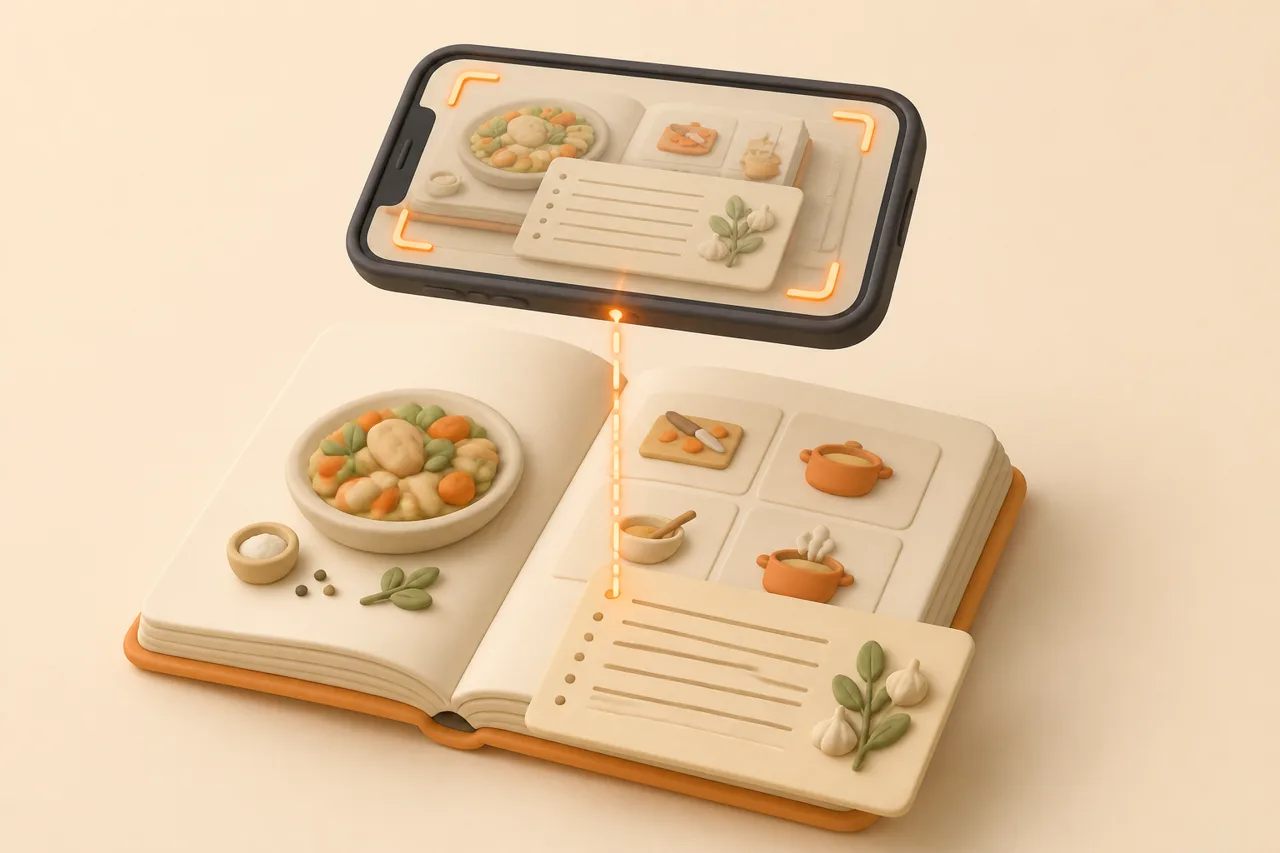
| Photo of a printed cookbook page | Strong, close to typed text | Curved spine, shadow, two columns read across | 20 seconds |
| Handwritten recipe card | The hardest source. Legible print is fine, cursive varies | Numbers, fractions and abbreviations such as tsp against tbsp | 60 seconds |
What does extraction get right almost every time?
Structure survives extraction better than detail does. The parts of a recipe that authors state explicitly come through cleanly across every source type.
- Ingredient names, including brand names and cuts of meat.
- Step order, because sequence is signalled by numbering, screen order or the word then.
- Oven temperatures and stated timings, which are usually written as digits.
- Servings, whenever the author says the number out loud or prints it.
- The source link, so credit and the original video stay attached.
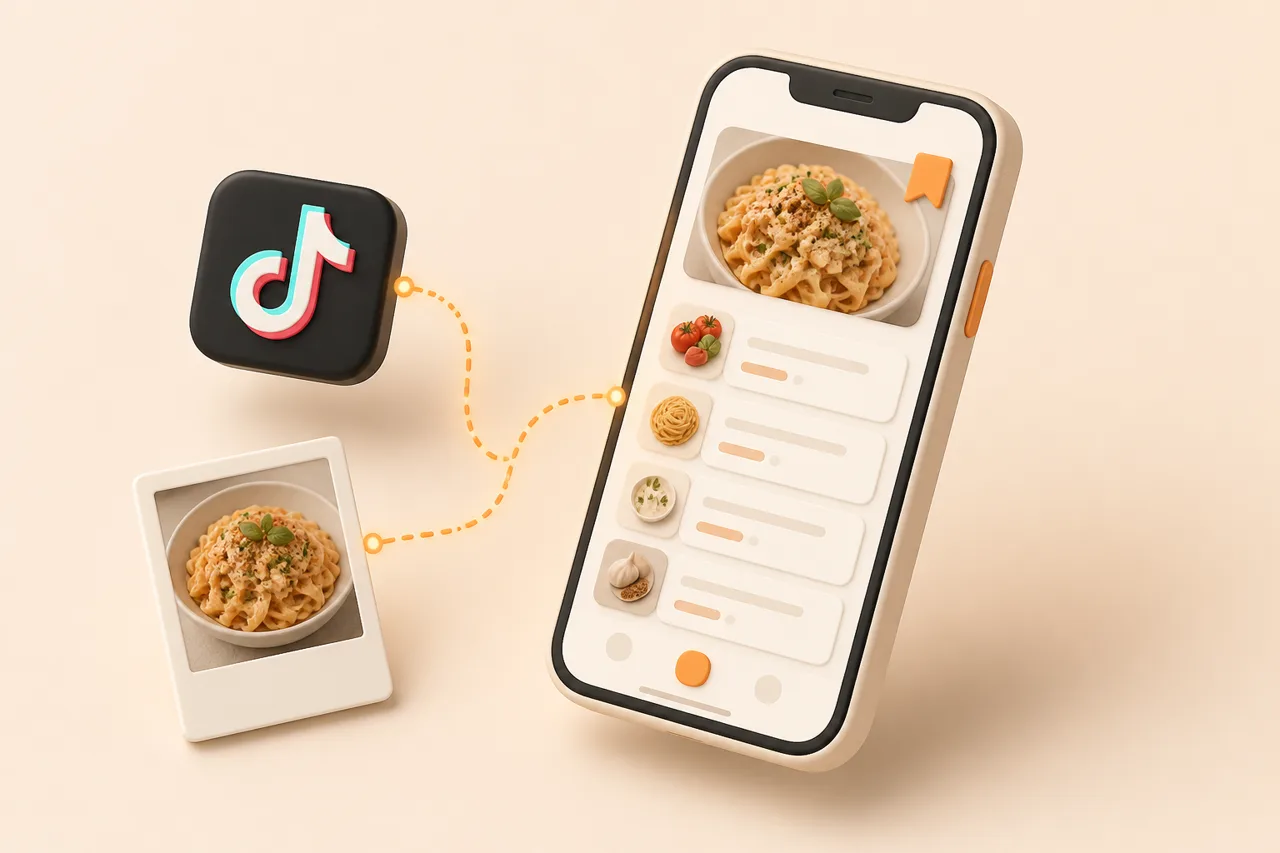
That is the reason a paste-and-check workflow beats typing. Even a source that needs 30 seconds of correction saves several minutes against transcribing by hand, which is the underlying case in save TikTok recipes.
Where does extraction still fail?
Failures cluster in places where the original never contained the information. No model can recover a quantity nobody wrote down.
Quantities that were never stated
A glug, a knob, a handful and season to taste are genuinely undefined. Extraction preserves the phrase rather than inventing a number, which is the correct behaviour and still leaves you a decision.
Implied steps and missing equipment
Creators skip what they consider obvious: pan size, resting time, whether the oven was preheated. The import mirrors the omission, so add those details while the video is fresh in your memory.
Pages and photos with more than one recipe
A cookbook spread with a main recipe and a variation, or a blog post listing 5 dishes, forces a judgement about where one recipe ends. Split them yourself by importing each separately.
Handwriting, fractions and abbreviations
Cursive numerals are the hardest characters on the page, and tsp against tbsp is a difference of one letter with triple the consequence. Cards written in a family shorthand need a read-through, which is why digitize handwritten recipe cards recommends checking numbers first.
Why are there no published accuracy percentages?
No independent benchmark for recipe extraction exists, so any single percentage you see is a marketing number rather than a measurement. There is no agreed test set, no agreed scoring method and no shared definition of a correct import.
Scoring would need answers to awkward questions first. Does a missing pan size count as an error? Is a glug transcribed faithfully a success or a failure? Until those are settled, describing accuracy by source type is the honest option.
Judge an importer on your own sources instead. Import 10 recipes you already know well, count the corrections you had to make, and note which source type produced them. That sample tells you more than any published figure would.
How do you verify an imported recipe in 20 seconds?
Check the 5 fields that ruin a dinner when wrong, in this order. Everything else can be fixed at the stove.
- 1Count the ingredients. Compare the number of lines against the source. A missing line is the most common error.
- 2Scan for the odd number. 500 g of salt or 2 cups of chilli flakes is a decimal or unit slip.
- 3Check the oven temperature and unit. A 180 that should be 350F, or the reverse, is the costliest single error.
- 4Confirm servings. Everything downstream, including scaling and grocery lists, depends on it.
- 5Read step 1 and the last step. Intros and sign-offs are what usually leak into the method.
How do you improve your own hit rate?
You control the input, which is the biggest lever available. Small habits at capture time remove most correction work later.
- Photograph cookbook pages flat, in even light, one page at a time, with no shadow across the gutter.
- Screenshot the whole ingredient list including the last line, rather than the visible portion.
- Prefer a creator's caption or pinned comment over the video when both exist, because typed text beats audio.
- Import within a day, while you still remember what a glug looked like.
- Compare app behaviour before committing a library: see ReciBites vs ChefTap, ReciBites vs Copy Me That and ReciBites vs ReciMe.
What does ReciBites extract from?
ReciBites imports from TikTok, Instagram, YouTube, Facebook, Pinterest and any website URL, and reads screenshots, photos of physical cookbook pages and handwritten recipe cards with OCR. Every import lands as editable fields, so a correction takes one tap rather than a retype.
Imported recipes then scale, convert measurements, adapt to dietary needs through the AI cooking assistant, and roll into weekly meal plans and aisle-grouped grocery lists. The cookbook route in particular is worth doing in batches, as set out in scanning a cookbook.
- JSON-LD
- A JSON format embedded in a web page that describes its content for machines. Recipe sites use it to publish ingredients, times and yields.
- Schema.org Recipe
- The shared vocabulary that names recipe fields, including recipeIngredient, recipeInstructions, cookTime and recipeYield.
- OCR
- Optical character recognition. Converting an image of text, such as a cookbook photo or a video caption, into editable characters.
- Ground truth
- The verified correct answer a system is scored against. Recipe extraction has no shared ground-truth set, which is why benchmarks do not exist.
Frequently asked questions
+How accurate is AI recipe extraction?
It depends on the source. Web pages with recipe schema import almost perfectly, video and printed pages need a short check, and handwriting needs a full read-through.
+Why did my recipe import with missing ingredients?
Usually the source lacked structured markup, or a screenshot cropped the last line. Compare the ingredient count against the original and add the missing line.
+Can AI read a handwritten recipe card?
Yes, though it is the hardest source. Clear printing reads well, cursive varies, and numbers and abbreviations such as tsp against tbsp are the errors worth checking.
+Is there a published accuracy rate for recipe importers?
No. There is no independent benchmark or shared test set, so any single percentage is a marketing claim rather than a measurement.
+Does AI extraction work on videos without captions?
Yes, by reading the spoken audio and on-screen text. Named ingredients and step order come through well, while amounts said as a glug stay vague.
+What is recipe schema markup?
A JSON-LD block in a page's source that labels the ingredients, instructions, times and yield. Importers read those named fields directly instead of guessing.
+How do I check an imported recipe quickly?
Count the ingredient lines, look for an implausible quantity, confirm the oven temperature and unit, check servings, then read the first and last step.
+Should I trust extraction for allergy-critical recipes?
Verify against the original source every time. Extraction can drop a line, and an allergen you did not see is a risk no import speed makes up for.
+Does extraction get better over time?
Models improve, but the ceiling is the source. A quantity the creator never stated cannot be recovered by any importer.
- #ai extraction
- #ocr
- #recipe import
- #accuracy