

AI and Smart Kitchen
How to convert recipe measurements between cups, grams and ml
A cup measures space and a gram measures mass, which is why 1 cup of flour has no single correct weight. Here are the conversions that hold up, and the ones that do not.
A recipe asks for 2 cups of flour. Your kitchen has a scale, a set of mismatched cups and a bag labelled in kilograms. That gap ruins more bakes than bad technique does, because a cup measures space and a gram measures mass, and the bridge between them changes with every ingredient.
This guide gives you the conversions worth memorising, the ones worth looking up, and the point where converting stops being worth your time. Keep the ingredient table open the next time you cook from a recipe written on the other side of an ocean.
What does converting recipe measurements mean?
Converting recipe measurements means translating a quantity from one measuring system into another so the amount of ingredient in the bowl stays the same. It covers three separate jobs that people treat as one: volume to volume, volume to weight, and temperature.
Volume to volume and temperature are pure arithmetic and always give the same answer. Volume to weight is the hard one, because a cup of honey and a cup of rolled oats occupy identical space and weigh nothing alike. Conversion is also a different problem from changing batch size, which is covered in how to scale recipe servings.
Why is 1 cup of flour not a fixed gram weight?
A cup of flour has no fixed weight because flour compacts. How you fill the cup decides how much flour fits into the same 240 ml of space, and the spread between the gentlest and the roughest filling method is around 30 g.
Spoon and level compared with scoop and sweep
The two common filling methods produce different amounts of the same ingredient. Most US recipe developers write for the first one and never say so.
- Spoon and level: spoon flour into the cup, then level the top with a knife. About 120 g to 125 g.
- Fluff, spoon and level: stir the bag first to aerate, then spoon. Closer to 120 g.
- Scoop and sweep: dip the cup into the bag and sweep off the top. 140 g to 150 g, because the dip packs it.
That is up to 25 percent more flour in a cake that was formulated for 120 g. Dry, tight crumb and a cookie that will not spread are usually this, not your oven.
What are the standard volume conversions?
Volume conversions are fixed numbers you can trust in any recipe. These are the ones worth committing to memory, using the US customary system as the base.
| Measure | Millilitres | In cups | US fluid ounces |
|---|---|---|---|
| 1 teaspoon | 5 ml | 1/48 cup | 0.17 fl oz |
| 1 tablespoon | 15 ml | 1/16 cup | 0.5 fl oz |
| 1/4 cup | 60 ml | 4 tablespoons | 2 fl oz |
| 1/3 cup | 80 ml | 5 tbsp plus 1 tsp | 2.7 fl oz |
| 1/2 cup | 120 ml | 8 tablespoons | 4 fl oz |
| 1 cup | 240 ml | 16 tablespoons | 8 fl oz |
| 1 pint (US) | 473 ml | 2 cups | 16 fl oz |
| 1 quart (US) | 946 ml | 4 cups | 32 fl oz |
How many grams is 1 cup of common ingredients?
Each ingredient has its own cup weight because density varies enormously. Use these as working numbers for spooned and levelled dry goods, and treat them as accurate to about 5 percent.
| Ingredient | 1 cup | 1/2 cup | 1 tablespoon |
|---|---|---|---|
| Water, milk, stock | 240 g | 120 g | 15 g |
| All-purpose or plain flour | 120 g | 60 g | 8 g |
| Bread flour | 130 g | 65 g | 8 g |
| Granulated or caster sugar | 200 g | 100 g | 12 g |
| Brown sugar, packed | 215 g | 108 g | 13 g |
| Icing or powdered sugar | 120 g | 60 g | 7 g |
| Butter | 227 g | 113 g | 14 g |
| Honey, treacle, golden syrup | 340 g | 170 g | 21 g |
| Rolled oats | 90 g | 45 g | 6 g |
| Cocoa powder | 85 g | 43 g | 5 g |
| White rice, uncooked | 195 g | 98 g | 12 g |
| Grated parmesan | 90 g | 45 g | 6 g |
Notice the honey row. Sticky liquids weigh more than double what the same volume of flour does, which is why swapping sugar for honey by volume goes wrong. The swap logic is in how to substitute ingredients.
How do US, metric and imperial cups differ?
Three different cups are in active use and none of them match. A recipe rarely tells you which one the author meant, so infer it from where the recipe was published.
- US cup: 240 ml. Used by American blogs, books and TV.
- Metric cup: 250 ml. Standard in Australia and New Zealand, about 4 percent larger.
- Imperial cup: 284 ml. Older British and Canadian books, nearly 20 percent larger than a US cup.
- Tablespoons: 15 ml everywhere except Australia, where the standard tablespoon is 20 ml.
The Australian tablespoon catches people out most often, because a recipe calling for 4 tablespoons of butter moves by 20 ml between systems. In soups nobody notices. In a custard or a caramel, it changes the set.
How do you convert oven temperatures?
Convert Fahrenheit to Celsius by subtracting 32 and multiplying by 5/9, then round to the nearest 5 degrees. Published recipes use rounded pairs rather than exact maths, so match the row below rather than the calculator.
| Fahrenheit | Celsius | Fan or convection | Gas mark |
|---|---|---|---|
| 300F | 150C | 130C | 2 |
| 325F | 165C | 145C | 3 |
| 350F | 175C | 155C | 4 |
| 375F | 190C | 170C | 5 |
| 400F | 200C | 180C | 6 |
| 425F | 220C | 200C | 7 |
| 450F | 230C | 210C | 8 |
Drop 20C for a fan oven and check 5 minutes early the first time you bake something. Oven thermostats drift, and a cheap oven thermometer settles the argument permanently.
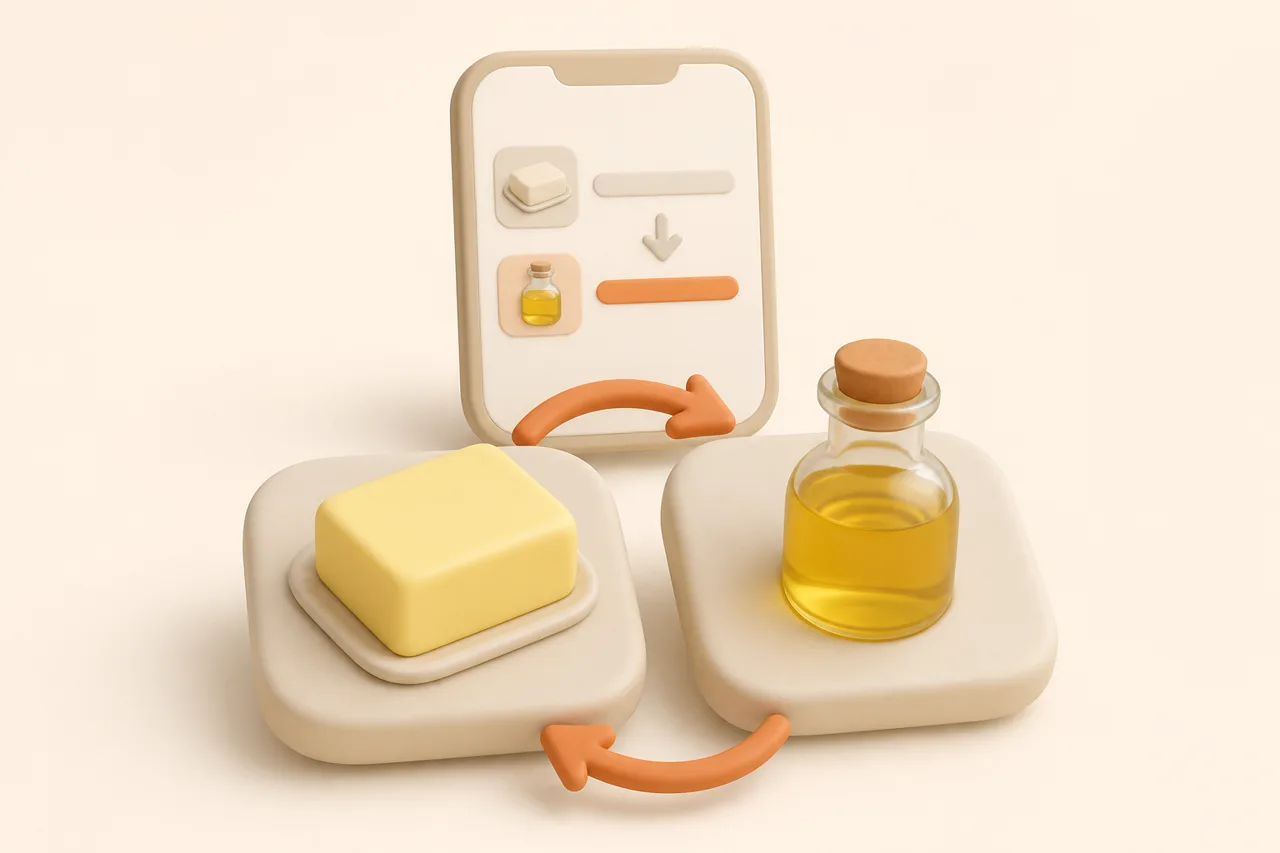
How do you convert butter, sticks and blocks?
1 US stick of butter is 113 g, which is 1/2 cup or 8 tablespoons. US butter arrives in 4-stick packs marked with tablespoon lines on the wrapper, while most of the world sells 250 g blocks with no markings at all.
- 1 stick = 113 g = 1/2 cup = 8 tablespoons = 4 oz.
- 2 sticks = 227 g = 1 cup. 4 sticks = 454 g = 1 pound.
- A 250 g European block quartered gives 62.5 g pieces, so 2 quarters is close to 1 stick.
- Cut a cold block into 1 cm slices from a 250 g bar and each slice is roughly 25 g.
When should you stop converting and buy a scale?
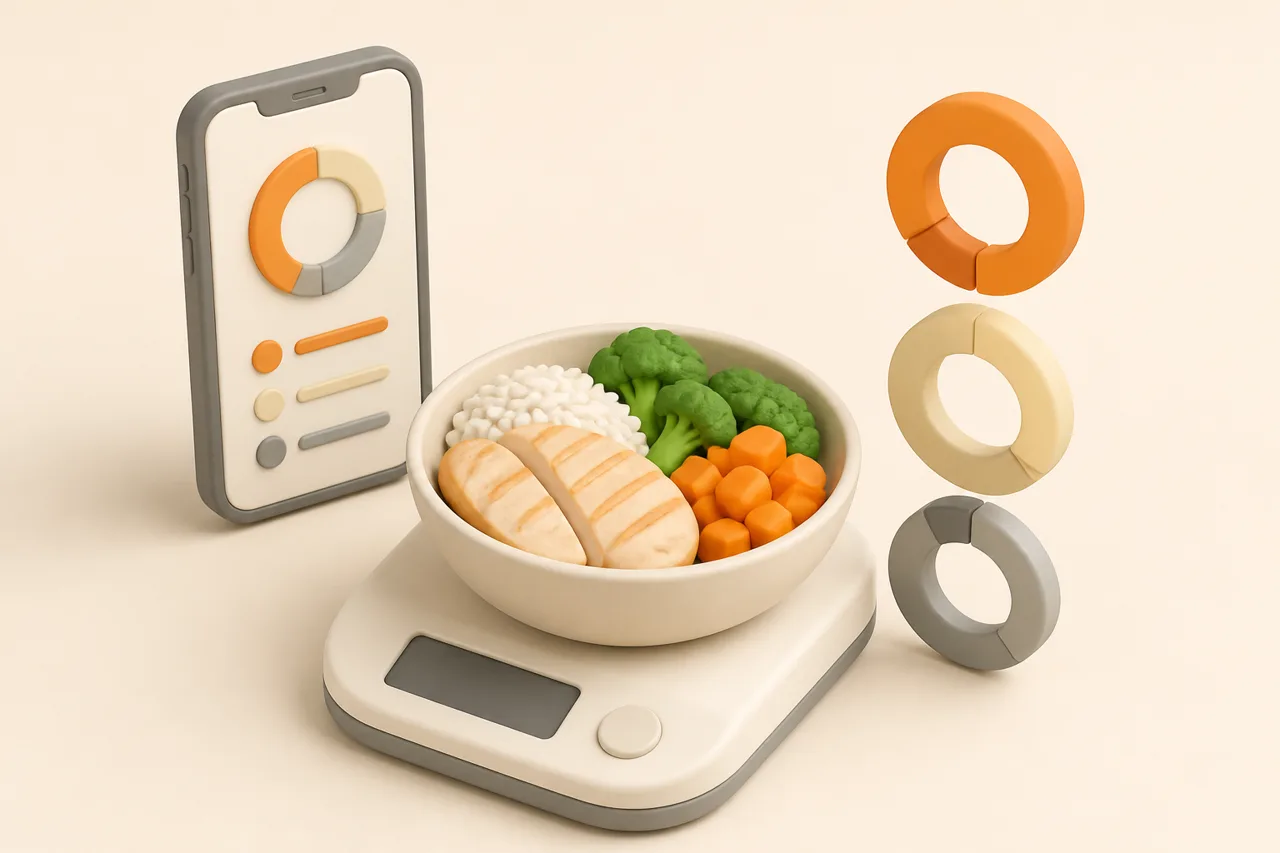
Buy a scale once you bake more than twice a month. A digital scale with a tare button removes the entire conversion problem for dry ingredients, and costs less than the flour you waste getting a cake wrong three times.
- 1You bake regularly. Bread, pastry and cake are ratio work, and ratios need mass.
- 2You cook from mixed sources. A library holding US blogs, British books and Australian videos needs one neutral unit.
- 3You batch cook. Weighing into one bowl on tare is faster than washing 6 cups.
- 4You are still on volume for savoury food only. Stews, soups and stir fries tolerate the wobble, so cups are fine there.
How does ReciBites convert measurements for you?
ReciBites converts measurements inside the saved recipe, so the ingredient list reads in the units you use rather than the ones the author wrote. It also scales servings, which applies the conversion to the adjusted quantity rather than making you do both steps.
- Import from a URL, a video or a photo and the quantities land as structured fields rather than a wall of text. Accuracy varies by source, as set out in how accurate AI extraction is.
- Ask the AI cooking assistant to restate an ingredient list in grams before you shop.
- Photograph a cookbook page and convert the result, using the method in scan a cookbook page.
- Apps differ sharply here: see ReciBites vs Paprika for a manual-first library, or ReciBites vs ChefTap for clipping-focused import.
- Density
- Mass per unit of volume. The reason 1 cup of honey weighs almost 3 times as much as 1 cup of oats.
- Tare
- The scale button that resets the reading to zero, so you can weigh ingredients one after another into the same bowl.
- Baker's percentage
- A bread notation where every ingredient is a percentage of the flour weight. It only works with mass, never with cups.
- Fan or convection oven
- An oven with a fan that circulates air, cooking faster and more evenly. Set it about 20C below a conventional recipe temperature.
Frequently asked questions
+How many grams is 1 cup of flour?
About 120 g to 125 g if you spoon flour into the cup and level it. Scooping straight from the bag packs it to 140 g or more, which is enough to dry out a cake.
+How many ml is 1 cup?
A US cup is 240 ml, a metric cup used in Australia is 250 ml, and an older imperial cup is 284 ml. Assume 240 ml unless the recipe is Australian or British.
+What is 350F in Celsius?
350F is 175C in a conventional oven, or about 155C in a fan oven. Gas mark 4 is the equivalent setting on a British gas oven.
+How many grams is a stick of butter?
113 g, which equals 1/2 cup, 8 tablespoons or 4 ounces. Two sticks make 227 g, and a full 4-stick pack is 454 g, or 1 pound.
+Can I convert cups to grams with one number?
No. The gram weight of a cup depends on the ingredient, so flour, sugar, butter and honey all convert differently. Use a per-ingredient table or a scale.
+Is an app better than a conversion chart?
An app converts the saved recipe itself, so the ingredient list stays in your units after scaling. A chart makes you redo the maths every time you cook.
+Do I need a scale for savoury cooking?
Rarely. Stews, soups and stir fries tolerate loose measurement. Bread, pastry and cake depend on ratios, so weigh those.
+How do I convert a recipe with no units at all?
Anchor it to the ingredient you can measure, usually flour or liquid, then estimate the rest as ratios against it. Write the numbers down the first time you cook it.
- #measurements
- #conversions
- #baking
- #grams
- #cups