


AI and Smart Kitchen
How to substitute ingredients without guessing
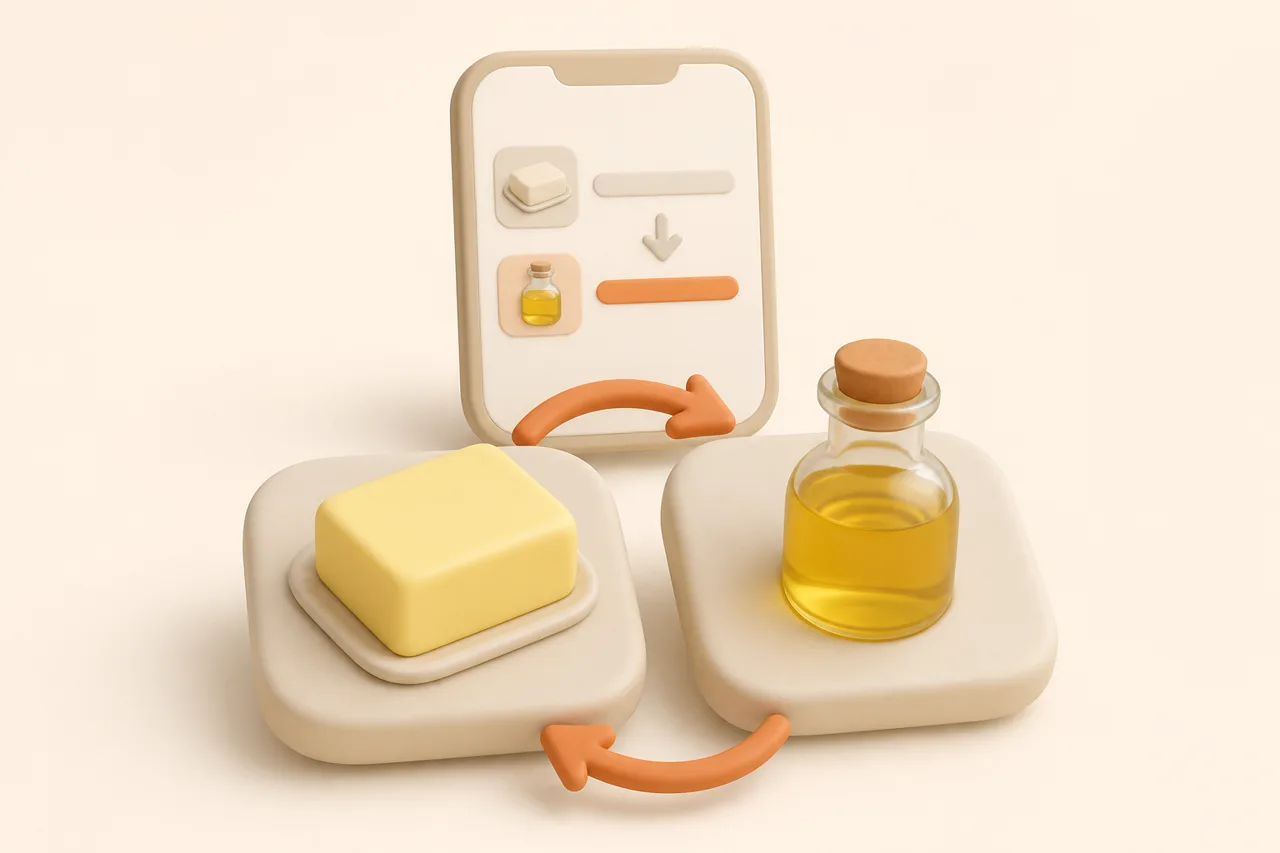
Every ingredient is doing a job. Work out the job first and the swap becomes obvious, including the times the honest answer is to cook something else.
You are 20 minutes into a recipe and the buttermilk is not in the fridge. The useful question is not what looks like buttermilk, it is what the buttermilk was there to do. Once you know the job, the shortlist of replacements writes itself.
This guide gives you a function-first method, a ratio table for the swaps that come up most often, and an honest list of the places where substituting will not save the dish.
What does substituting an ingredient actually mean?
Substituting an ingredient means replacing it with something that performs the same job in the recipe, at a ratio that keeps the balance of the dish intact. It is a functional swap, not a lookalike swap, which is why oil can stand in for butter and margarine sometimes cannot.
Most bad substitutions come from matching category instead of function. Almond milk and whole milk are both milk, but one carries fat and protein that brown and set, and the other mostly carries water.
Ask two questions before every swap. What would go wrong if this ingredient were left out entirely, and which property of it prevents that? The answer names the function you need to replace.
What job is the ingredient doing?
Name the function before you pick a replacement. Almost everything in a home recipe is doing one of 6 jobs, and several ingredients do two at once.
- Fat: carries flavour, coats flour to keep baked goods tender, conducts heat. Butter, oil, cream, tahini.
- Acid: brightens, tenderises, activates baking soda. Lemon, vinegar, yoghurt, buttermilk.
- Binder: holds a mixture together. Eggs, flax, chia, breadcrumbs, starch.
- Leavening: creates lift. Baking powder, baking soda plus acid, whipped egg white, yeast.
- Liquid: hydrates flour, makes steam, thins a sauce. Water, milk, stock, wine.
- Sweetener: sweetens, browns, holds moisture. Sugar, honey, maple syrup, dates.
Eggs are the classic double agent. In a burger patty an egg is a binder, in a sponge it is leavening and structure, so the correct replacement differs entirely between the two dishes.
Which substitutions work reliably?
These swaps hold up in normal home cooking and are the ones worth knowing by heart. Ratios are by volume unless the row says otherwise.
| Missing ingredient | Use instead | Ratio | Where it breaks |
|---|---|---|---|
| Buttermilk, 1 cup | Milk plus lemon juice or white vinegar | 1 cup milk plus 1 tbsp acid, rest 10 minutes | Nothing much. The most reliable swap listed here |
| Self-raising flour, 1 cup | Plain flour plus baking powder | 1 cup flour plus 1.5 tsp baking powder | Old baking powder, which loses lift after a year |
| Baking powder, 1 tsp | Baking soda plus cream of tartar | 1/4 tsp soda plus 1/2 tsp cream of tartar | Soda alone, which needs an acid in the batter |
| Butter in a cake, 100 g | Neutral oil | 80 g oil, because butter is about 16 percent water | Creamed cakes, shortcrust and laminated dough |
| Egg as a binder | Ground flaxseed and water | 1 tbsp flax plus 3 tbsp water, rest 5 minutes | Sponges, meringue and custard, which need egg lift |
| Sour cream | Full-fat Greek yoghurt | 1 for 1 | Boiling sauces, where lower-fat yoghurt splits |
| Fresh herbs, 1 tbsp | Dried herbs of the same type | 1 tsp dried, added earlier in cooking | Basil, parsley and coriander, poor dried |
| Sugar, 1 cup | Honey or maple syrup | 3/4 cup, minus 3 tbsp of other liquid, oven 15C lower | Meringue and caramel, which need dry crystals |
| Cornflour for thickening, 1 tbsp | Plain flour | 2 tbsp flour, cooked out longer | Clear glazes, since flour clouds a sauce |
| White wine, 1/2 cup | Stock plus a splash of vinegar | 1/2 cup stock plus 1 tsp vinegar | Reductions built mostly on the wine |
The rows that need a second adjustment
Two swaps change more than one variable. The butter to oil ratio only works if you weigh both, so keep the rules in convert recipe measurements to hand, and the honey row needs the oven drop because syrup browns faster than granulated sugar.
Where do substitutions fail?
Swaps fail where chemistry, not flavour, is doing the work. The more precise the structure of the finished dish, the less room a substitution has.
Baking, where ratios are the recipe
Bread, pastry and cake are formulas with tolerances, so changing one component changes hydration, gluten development or lift. A gluten-free flour blend without a binder such as xanthan gum will not hold a crumb together, which is the core of managing gluten-free recipes.
Emulsions and custards
Mayonnaise, hollandaise and creme patissiere depend on egg proteins and fat behaving in a specific way. Lower-fat or plant-based replacements often refuse to hold, and no ratio adjustment fixes a broken emulsion after the fact.
Anything where the ingredient is the dish
Substituting the star does not produce a variation, it produces a different recipe. Cook the thing you have ingredients for and save the original for another night.
How do you make allergy-safe swaps?
For allergies, treat the substitution as a labelling task first and a cooking task second. The functional swap is often easy, while the risk sits in shared equipment and hidden derivatives.
Hidden sources are the ones that catch experienced cooks. Wheat turns up in soy sauce and stock cubes, dairy in some breads and crisps, and nuts in pesto and curry pastes that never mention them on the front of the jar.
- 1Nut butters: sunflower seed butter or tahini match the texture, and pumpkin seeds replace pine nuts in pesto.
- 2Dairy: oat milk behaves closest in baking, coconut cream stands in for double cream, and details are in dairy-free substitutes.
- 3Soy sauce: coconut aminos for soy allergies, or tamari where the issue is the wheat rather than the soy.
- 4Eggs: flax or chia for binding, aquafaba whipped for aeration, commercial replacer for structure in cakes.
- 5Check the label every time. Formulations change, and may-contain warnings vary by production run.
How do you test a swap without wasting dinner?
Test one variable at a time and write down what happened. Two changes at once means you learn nothing when the result is worse.
Savoury cooking gives you room to test cheaply, since a stew tolerates a wrong guess and tells you within a taste. Save the risky experiments for a Tuesday rather than the night you have people coming.
- 1Change a single ingredient in a recipe you have already cooked successfully.
- 2Halve the batch if the swap is in baking, so a failure costs less flour.
- 3Taste the raw mixture where it is safe to, since acid and salt levels are fixable before the oven.
- 4Note the result in the recipe itself, including the ratio and the oven adjustment.
- 5Repeat the successful version once before you trust it for guests.
How does ReciBites handle substitutions?
ReciBites applies the swap to the recipe you saved rather than to a generic chart. The AI cooking assistant adapts a saved recipe for halal, vegan, gluten-free and allergy requirements, working from your actual ingredient list and quantities.
That matters most on the second cook. A swap you worked out in March is worthless in June if it lived on a sticky note, and a household cooking for two diets needs the adjusted amounts written down rather than remembered.
- Ask the AI cooking assistant to rework a saved recipe for the diet you cook for.
- Use fridge suggestions to find recipes that fit what you already have, rather than swapping around a missing item.
- Scale servings and convert units after the swap, so the adjusted ratios carry through.
- Comparing approaches helps: ReciBites vs Flavorish leans on generation, while ReciBites vs Mealime uses curated recipes with fixed swaps.
- Aquafaba
- The liquid from a tin of chickpeas. It whips like egg white and works as an aerating egg replacement.
- Emulsion
- A stable mix of fat and water held together by an emulsifier such as egg yolk or mustard. Mayonnaise and hollandaise are emulsions.
- Xanthan gum
- A binder added to gluten-free flour blends to mimic the structure gluten would otherwise provide.
- Flax egg
- 1 tablespoon of ground flaxseed mixed with 3 tablespoons of water and rested until gel-like. Binds, but does not leaven.
Frequently asked questions
+What can I use instead of buttermilk?
Add 1 tablespoon of lemon juice or white vinegar to 1 cup of milk and rest it 10 minutes until it thickens slightly. Use it exactly as the recipe says.
+How do I replace an egg in baking?
Depends on the egg's job. For binding use 1 tablespoon ground flaxseed with 3 tablespoons water. For lift use whipped aquafaba, since flax does not aerate.
+Can I use oil instead of butter in a cake?
Yes, at about 80 percent of the butter weight, because butter is roughly 16 percent water. Avoid it in recipes that cream butter and sugar for aeration.
+What is the ratio for dried herbs instead of fresh?
Use 1 teaspoon of dried for every tablespoon of fresh, and add it earlier in cooking so it rehydrates. Basil, parsley and coriander suffer most when dried.
+Can I swap baking soda for baking powder?
Not directly. Baking soda needs an acid in the batter, and it is roughly 3 times stronger. Replace 1 teaspoon of powder with a quarter teaspoon of soda plus half a teaspoon of cream of tartar.
+Which recipes should I not substitute in?
Laminated pastry, meringue, caramel, custards and emulsions. Those depend on exact ratios and protein behaviour, so a swap changes the outcome rather than the flavour.
+How do I substitute ingredients for an allergy safely?
Match the function, then read the label on the replacement on the day you cook. Watch for shared equipment warnings, which change between production runs.
+Can an app suggest ingredient substitutions?
Yes. The ReciBites AI cooking assistant adapts a saved recipe for halal, vegan, gluten-free and allergy needs, working from your own ingredient list rather than a generic chart.
- #substitutions
- #baking
- #allergies
- #dairy free
- #cooking