

AI and Smart Kitchen
What is an AI cooking assistant, and what can it actually do?
An AI cooking assistant is very good at four jobs and unreliable at three others. Here is the capability map, the failure modes and how to tell a correct answer from a plausible one.
Ask a chatbot to halve a curry and it will do a better job than most people do at the counter. Ask it whether the chicken in your fridge is still fine and it will answer with exactly the same confidence, having no way to know.
That gap is the whole story of cooking assistants. This is a capability map: 4 jobs worth handing over, 3 you should not, and a test for spotting the difference in an answer you are reading at the stove.
What is an AI cooking assistant?
An AI cooking assistant is a conversational layer over a recipe that answers questions about it and rewrites it on request. It changes quantities, swaps ingredients, converts units, adapts a dish to dietary rules and explains techniques, using the recipe in front of you as context.
The context part is what separates it from a general chatbot. An assistant built into a recipe app already knows the ingredient list, the servings and the method, so "make this dairy-free for 6" is a complete instruction rather than a paragraph you have to paste in.
What does an AI cooking assistant do well?
It is reliable on tasks that are arithmetic, lookup or explanation. All 4 of these are things where the correct answer is well documented and the assistant is recombining rather than judging.
Substitutions
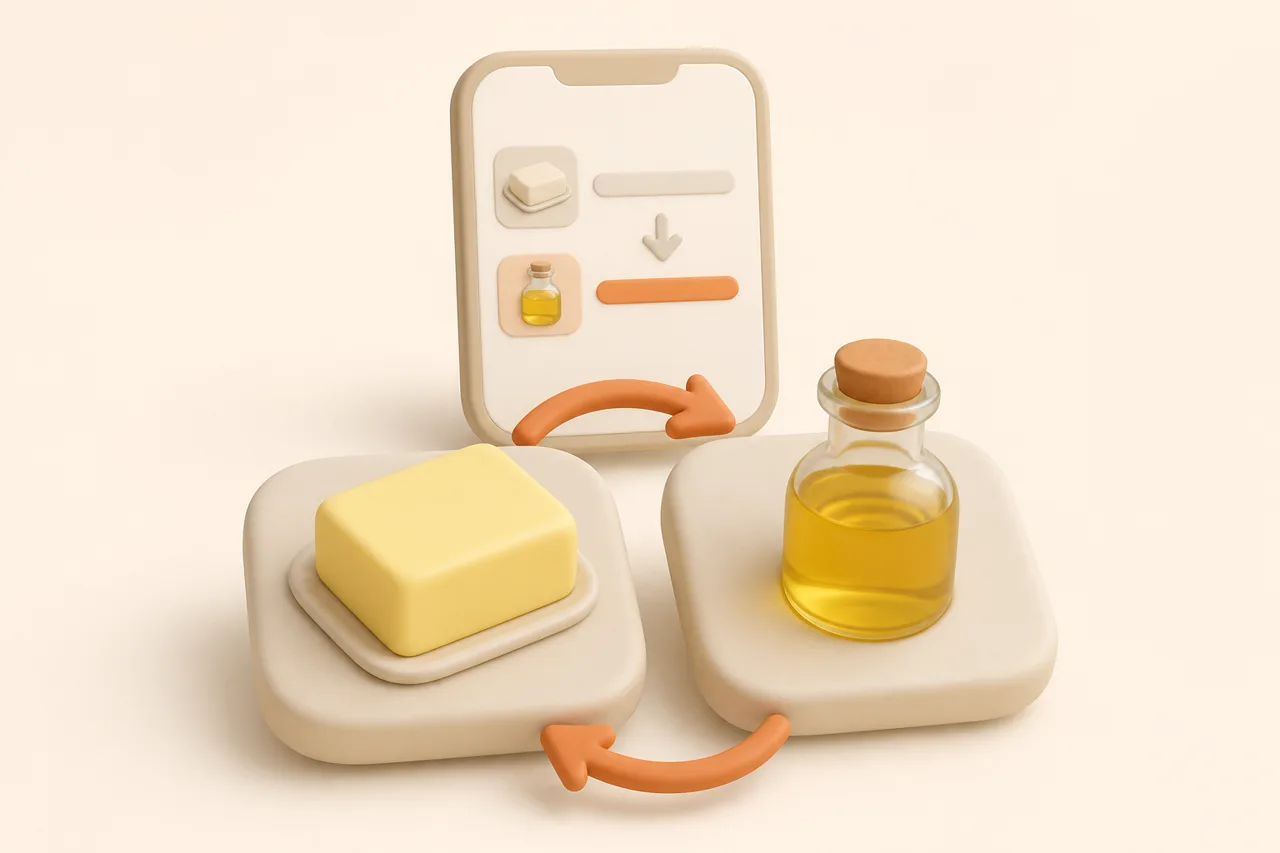
Ingredient swaps are its strongest use, because the useful answer is a ratio and a warning. A good response tells you buttermilk can be replaced with milk plus a tablespoon of lemon juice per cup, and that the texture will be slightly thinner.
Push for the trade-off rather than accepting the swap alone. The reasoning behind the common ratios is in how to substitute ingredients, and knowing it makes bad suggestions obvious.
Scaling and conversion
Multiplying quantities and converting between cups, grams, millilitres and ounces is arithmetic, and assistants handle it accurately. The judgement calls around scaling — salt, spice and pan size — are covered in how to scale recipe servings.
Dietary rewrites
Rewriting a dish as vegan, gluten-free or halal is pattern work an assistant does quickly and comprehensively, often catching an ingredient you would have missed such as fish sauce or gelatine. Treat the output as a first draft for anyone with a real allergy.
Technique questions
"Why did my sauce split" and "what does folding mean" are exactly the questions it answers well, because they are explanation rather than observation. You get a clear answer without scrolling past 4 ads and a video.
The pattern across all 4 is that the assistant is retrieving and rearranging settled knowledge. Nothing in that list requires it to know anything about your kitchen, your ingredients or the last 10 minutes.
What does it get wrong?
It fails wherever the right answer depends on chemistry, on your specific kitchen, or on something only a human can sense. These failures are worth knowing individually, because they do not look like failures on screen.
Baking chemistry
Baking is the most common bad answer. An assistant will happily swap plain flour for almond flour at 1:1, or halve an egg, and the result is a formally correct-looking recipe that produces a dense, flat disaster.
Flour, eggs, sugar, fat and leavening are structural. Changing one changes hydration, gluten development or rise, and the assistant is pattern-matching on text rather than modelling any of that.
Food safety
Never delegate a safety judgement. An assistant cannot see, smell or temperature-probe anything, so questions about whether leftovers are still good, whether a marinade can be reused, or whether pork is cooked through are outside what it can know.
Precise timings
Timings from an assistant are averages, not predictions for your oven. Domestic ovens routinely run 10 to 20 degrees off their dial, pans vary in thickness, and "25 minutes" assumes a setup nobody described to it.
How do you tell a good answer from a plausible one?
Judge the shape of the answer, not the tone. Every response sounds equally confident, so confidence carries no information and the details do.
| Task | Trust level | What a good answer contains |
|---|---|---|
| Ingredient swap | High | A ratio, a named alternative and the trade-off you will taste |
| Unit conversion | High | The number, plus a note that cups of flour vary by how it is packed |
| Scaling servings | High for volume, medium for seasoning | Scaled quantities plus a flag on salt, spice, pan size and time |
| Dietary rewrite | Medium | The obvious swaps plus the hidden ones such as gelatine or fish sauce |
| Baking adaptation | Low | An explicit warning that structure changes, not a clean 1:1 swap |
| Is this still safe to eat | None | A refusal and a pointer to food safety guidance |
Apply one more filter on top of the table. If the answer would change depending on something the assistant cannot observe — your oven, your pan, how old the ingredient is — then the answer is a starting point rather than an instruction.
That single test catches most of the damage. It marks scaling as safe, baking swaps as suspect and safety questions as off-limits, without you needing to remember which category each task falls into.
How should you prompt it?
Give it the constraint, the reason and the context in one message. Vague questions produce generic answers, and the assistant will not ask you for the missing information.
- 1Name the constraint. "No dairy" beats "make it healthier", which means nothing measurable.
- 2Say why. An allergy needs a stricter answer than a preference, and the wording changes if you say so.
- 3Give the fixed points. The pan you own, the servings you need, the time you have.
- 4Ask for the trade-off. "What will this change about the texture" catches most bad suggestions.
- 5Ask for a doneness cue. Then cook to the cue and treat the stated time as a rough guide.
Allergy questions deserve a second source every time, because a missed derivative is not a texture problem. The checking routine is in adapting recipes for allergies.
How is it different from a recipe generator?
An assistant works on a recipe that already exists; a generator invents one. That difference decides how much verification you owe the output.
- An assistant is anchored. It edits a tested recipe, so errors are bounded by the original.
- A generator is unanchored. Nobody has cooked the thing it just wrote, including the model.
- Assistants fail visibly. A bad swap in a recipe you know looks wrong on the page.
- Generators fail late. You find out at the oven, with the ingredients already spent.
Both have a place, and the trade-offs are compared in AI recipe generators versus organizers. For a weeknight, anchored beats inventive almost every time.
What does the ReciBites assistant do?
ReciBites includes an AI cooking assistant that adapts recipes for dietary needs including halal, vegan, gluten-free and allergies, scales servings and converts measurements. It works on the recipes already in your library rather than on a blank prompt box.
It also suggests recipes from leftover fridge ingredients, which is the same assistant pointed at a different problem and covered in cooking from your fridge. Adapted recipes flow into weekly meal plans and grocery lists that merge duplicates and group by aisle. ReciBites is free to download with an optional Pro subscription.
Rival approaches differ mainly in how much they lead with chat: see Flavorish compared for generation-first, Samsung Food compared for an assistant wrapped in a social network, and Paprika compared for a manual library with no AI at all.
For a different application of AI to food, ReciBites vs Cal AI covers estimating a meal from a photograph and where that method breaks down.
- Context window
- The recipe and conversation the assistant can see when answering. An in-app assistant already holds the recipe, so you do not paste it.
- Hallucination
- A fluent, confident answer that is factually wrong. In cooking it usually appears as an invented ratio or an unsourced timing.
- Doneness cue
- An observable signal that food is ready — internal temperature, colour, texture — as opposed to a clock time.
- Dietary rewrite
- Regenerating a recipe so every ingredient satisfies a rule such as halal, vegan or gluten-free, including hidden derivatives.
Used inside its competence, an assistant removes the small friction that stops people cooking what they saved. Used outside it, the assistant is a confident stranger, and the same caveats apply to import quality in AI recipe extraction accuracy.
Frequently asked questions
+What is an AI cooking assistant?
A conversational layer over a recipe that answers questions about it and rewrites it — scaling servings, swapping ingredients, converting units and adapting for dietary rules — using the recipe as context.
+Can AI substitute ingredients accurately?
Usually yes for aromatics, dairy, acids and fats, where the answer is a known ratio. Treat baking swaps as unreliable, since flour, eggs and leavening change structure rather than flavour.
+Can I trust AI with baking recipes?
Not for adaptations. Assistants suggest 1:1 flour swaps and halved eggs that look correct and bake badly. Use a tested baking recipe and change one variable at a time.
+Can AI tell me if my leftovers are safe?
No. It cannot see, smell or probe your food, and its answers are averages. Follow local food safety guidance and use the 3 to 4 day rule for cooked leftovers.
+Are AI cooking times accurate?
Treat them as averages. Domestic ovens run 10 to 20 degrees off their dial, so ask for a doneness cue such as internal temperature or colour and cook to that.
+How do I ask an AI cooking assistant a good question?
Name the constraint, say why it matters, give your pan and serving count, and ask what the change will do to texture or taste.
+Is an AI cooking assistant the same as a recipe generator?
No. An assistant edits a recipe that already exists, so errors stay bounded. A generator invents a dish nobody has cooked, which needs far more verification.
+Can an AI cooking assistant make a recipe vegan or halal?
Yes, and it usually catches hidden ingredients like gelatine or fish sauce. Verify independently if the requirement is an allergy or a religious rule rather than a preference.
- #ai assistant
- #cooking ai
- #substitutions
- #smart kitchen