

Meal Planning and Groceries
How long does meal planning take, and where does the time go?
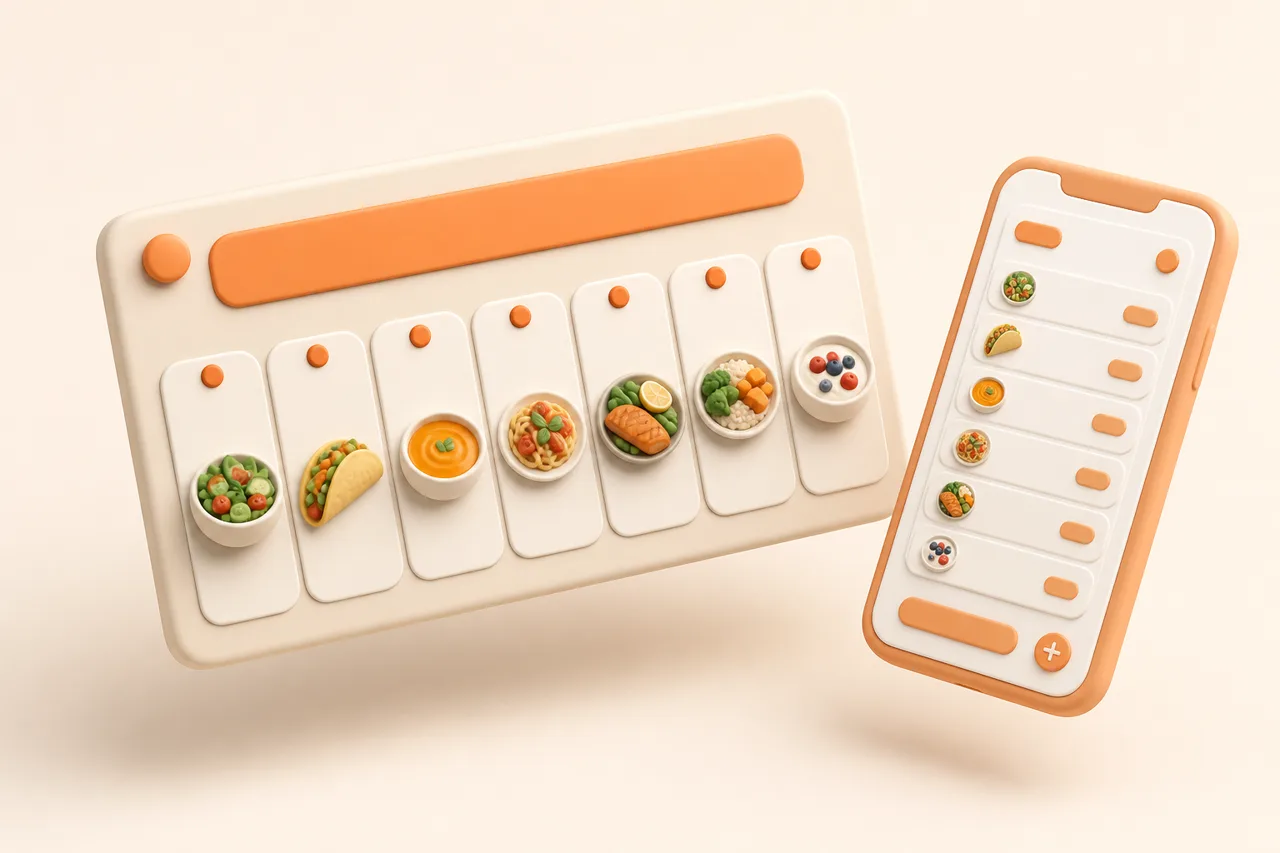
The cooking is not the slow part. Deciding 5 meals and writing the list is, and both are the parts that can be reduced to minutes.
People abandon meal planning because of how long it takes, not because they disagree with it. Worth knowing, then, where that time actually goes, because it is not distributed the way most advice assumes.
This article breaks a planning session into its steps with rough timings, identifies the 2 that dominate, and covers what each part looks like once it is automated.
What does a planning session involve?
Five steps, and they are worth separating because they do not cost the same. The middle one is where the hour goes.
- 1Checking the week. Which nights are busy, who is out, when there is time to cook.
- 2Deciding the meals. Choosing 4 or 5 dishes that fit those constraints and that people will eat.
- 3Retrieving the recipes. Finding the ingredient lists for what you chose.
- 4Writing the list. Combining those ingredients, removing what you already have, ordering it usefully.
- 5Checking the cupboards. Working out what is already in before you buy more.
Step 2 is the expensive one and it is expensive for a specific reason: it is a memory task done while tired. You are trying to recall recipes you liked, with no list in front of you, which is the hardest way to make 5 decisions.
Where does the time actually go?
These are rough figures for a household of 2 to 4 planning 4 or 5 dinners, and they vary with how organised the recipe collection already is.
| Step | Manual | Automated | Why it changes |
|---|---|---|---|
| Checking the week | 5 minutes | 5 minutes | Only you know this |
| Deciding the meals | 20 to 30 minutes | 2 minutes | A draft replaces a blank page |
| Retrieving recipes | 10 minutes | 0 | Already in the library |
| Writing the list | 15 to 20 minutes | 1 minute | Merged and sorted from the plan |
| Checking cupboards | 5 minutes | 5 minutes | Still a physical task |
| Total | 55 to 70 minutes | About 13 minutes |
The pattern is consistent: the steps that only you can do stay the same, and the steps involving recall and arithmetic collapse. That is a reasonable definition of what automation is worth here.
Why is deciding the slowest part?
Because of the blank page. Asked what shall we eat on Tuesday with nothing in front of you, the honest answer is that you cannot remember most of the recipes you know, so you default to the same 5 dishes.
This is why people with 200 saved recipes still cook the same rotation. The recipes exist and are not retrievable at the moment of deciding, which is a memory problem rather than a shortage of options, and why saved recipes get lost covers the mechanism.
Anything that puts options in front of you fixes most of it. A generated draft is one way; a physical list of 25 recipes on the fridge is another, and both work because they replace recall with recognition.
How do you cut it to 15 minutes?
Four changes, in order of how much time each returns. The first 2 do most of the work.
- Generate a draft instead of starting blank. Editing 2 nights of a proposed week takes minutes; inventing 5 takes half an hour.
- Build the list from the plan. Merging duplicates and sorting by aisle is arithmetic, and doing it by hand is where 15 minutes disappears.
- Plan 4 dinners, not 7. Less to decide, and leftovers and a takeaway cover the rest anyway.
- Keep recipes in one searchable place. Retrieval time goes to nothing, and the decision step gets easier as a side effect.
The 4-dinner point does double duty. It reduces planning time directly and it makes the plan more robust, since a 7-night plan assumes no changed arrangements and no leftovers. Meal plan for a week covers the routine, and organize a grocery list by aisle covers the shop-order step.
Why does a tidy library make planning faster?
Because the deciding step is a search problem, and the quality of the collection determines how long it takes. Two libraries of 100 recipes can differ by 20 minutes a week purely on how they are organised.
Three properties do the work. Titles you would actually search for, since a creator's caption tells you nothing in 3 months. Labels for cooking time, because that is the attribute you choose by on a Tuesday rather than cuisine. And no duplicates, since 3 copies of one dish make every search a comparison exercise, as how apps detect duplicate recipes covers.
- Rename recipes to the protein and the method: chicken traybake, not the original caption.
- Tag by time, under 20 minutes and over 40, rather than by cuisine.
- Delete near-duplicates, keeping whichever version you have cooked and annotated.
- Check the yield, since a wrong serving count makes every quantity downstream wrong.
This is a one-off cost that reduces a recurring one, which is the best trade available in any weekly routine. An afternoon spent on 25 recipes pays back within a month, and it makes an automated draft noticeably better as a side effect, because the planner has better information to work from. It is also the rare kind of tidying that stays done, since a renamed recipe does not drift back to its old title the way a tidy cupboard drifts back to being untidy over a fortnight of normal use.
What does it save beyond time?
Two things, and the second is the one people underestimate. The shop gets shorter, because one merged list in aisle order is a single pass rather than 2 laps and a forgotten item.
The larger saving is waste. A planned week buys ingredients that have a designated use, so the half bag of spinach bought speculatively stops happening. Households commonly throw away close to a quarter of what they buy, and a plan is the cheapest available correction, which reduce food waste at home covers.
There is also the decision you stop making every evening at 6pm. That does not show up in a time calculation and it is the reason most people who plan consistently keep doing it, and how much does meal planning save covers the money side. If your constraint is price rather than time, planning around offers covers a looser style of plan that follows the deals rather than fixing the dishes in advance. It takes slightly longer at the shop and less at the table.
On apps, ReciBites vs Plan to Eat covers manual planning from your own library and ReciBites vs Mealime covers plans built from an app's own recipes.
- Blank page problem
- Being asked to decide meals from memory with nothing in front of you, which is why people default to the same few dishes.
- Recall against recognition
- Remembering options unaided is far harder than choosing from a list, which is why a generated draft speeds up planning.
- Aisle grouping
- Sorting a grocery list by shop section so the trip is a single pass rather than several laps.
Frequently asked questions
+How long does meal planning take?
About 45 to 60 minutes a week done manually for 4 or 5 dinners. Roughly 15 minutes once the deciding and list-writing are automated.
+Which part takes the longest?
Deciding what to cook, at 20 to 30 minutes. It is a memory task done while tired, which is the slowest way to make 5 decisions.
+Why do I always cook the same meals?
Because deciding relies on recall. Most of your recipes are not retrievable at the moment you need them, so you default to the few you remember.
+How many dinners should I plan?
Four rather than 7. Less to decide, and leftovers, changed arrangements and one takeaway usually fill the remaining nights anyway.
+Does automating planning actually save time?
Yes, on the mechanical steps. Deciding drops from around 25 minutes to 2, and list-writing from 15 to about 1. The rest is unchanged.
+What is the fastest single improvement?
Building the shopping list from the plan rather than by hand. Merging duplicates and sorting by aisle is arithmetic and it takes 15 minutes manually.
+Does planning save money as well as time?
Mostly through waste. Ingredients bought for a specific meal get used, and households commonly throw away close to a quarter of what they buy.
+How long should the weekly session be?
Aim for 15 minutes. If it regularly takes an hour, the problem is usually the deciding step rather than a lack of discipline.
- #meal planning
- #grocery list
- #workflow
- #time saving