

Meal Planning and Groceries
How to meal plan for a week in 20 minutes
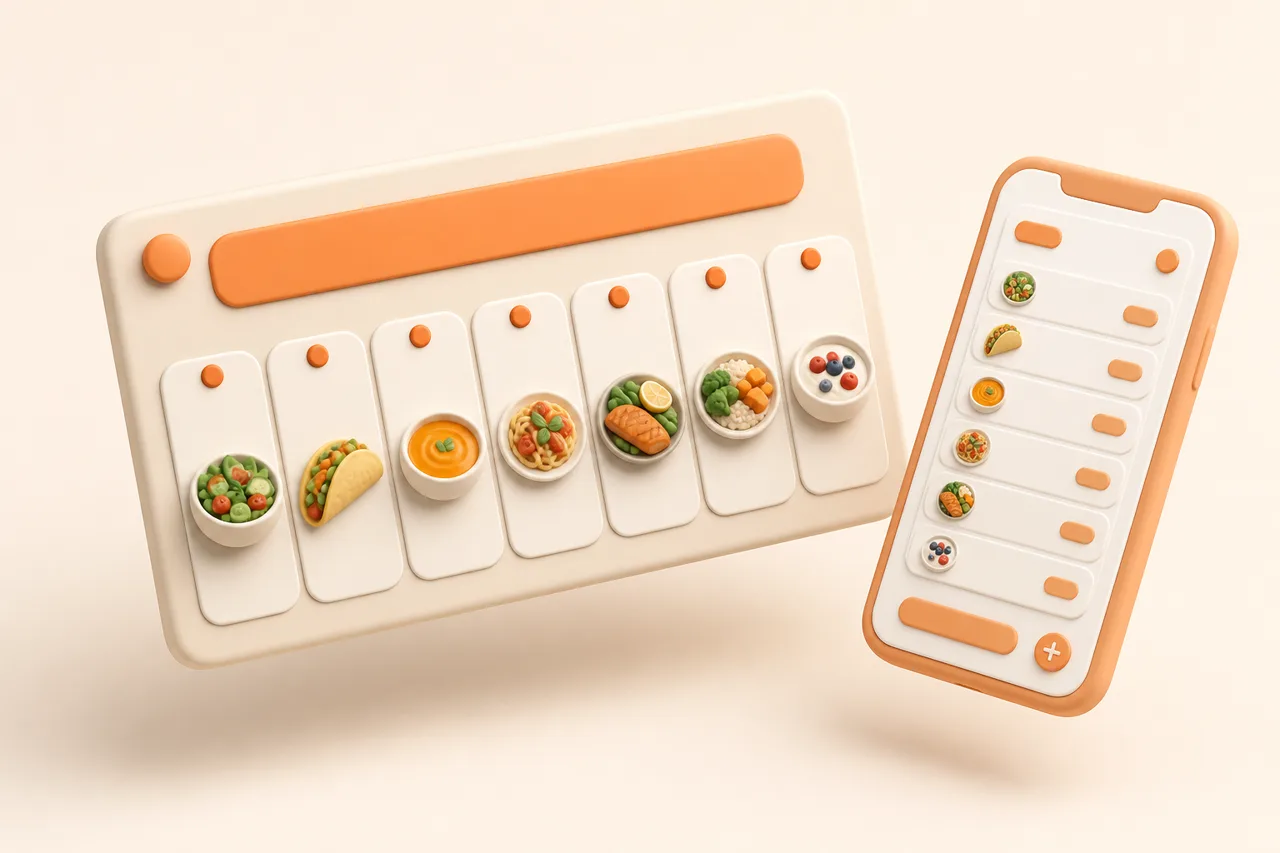
Most weekly meal plans fail because planning has no end time. Here is a 20-minute routine with 5 timed blocks that produces 7 dinners and one grocery list.
Meal planning rarely fails at the cooking stage. It fails on Sunday afternoon, when you open a notes app, scroll saved recipes for 40 minutes, feel behind, and close it again with nothing decided.
The fix is a stop time. This guide gives you a 20-minute routine split into 5 timed blocks, each with one output, so the plan finishes whether or not you feel inspired. Run it once and you will have 7 dinners settled and a single shopping list.
What is a weekly meal plan?
A weekly meal plan is a decision about which meals you will cook on which days, plus the single shopping list those meals require. It is a scheduling artefact, not a menu: the value sits in having decided in advance, not in the meals being ambitious.
That definition rules a lot out. A plan is not a folder of saved recipes, a Pinterest board or a vague intention to eat better. If it does not say what happens on Tuesday and what you need to buy for it, you will still be deciding at 18:30 with the fridge door open.
Why does planning usually take 2 hours?
Planning expands because you are doing 4 jobs at once and none of them has a boundary. Browsing for inspiration, checking the fridge, assigning days and writing a list are separate tasks, and mixing them means every recipe you consider sends you back to the fridge to check whether you have paprika.
- Open-ended browsing. With no shortlist, every scroll adds candidates instead of removing them.
- Planning 7 new meals. Seven distinct recipes means 7 sets of ingredients and a list nobody wants to shop.
- No inventory step. You buy a third jar of cumin and let the spinach in the drawer die.
- Copying ingredients by hand. Six recipe pages become 60 handwritten lines, with duplicates you never notice.
Each of those has a fixed-time replacement. That is what the blocks below do, and it is why the routine holds up on a week when you are tired.
How do you split the 20 minutes?
Give each block a timer and a single output, then move on even if the block is imperfect. An imperfect Thursday is fixable on Thursday; an unfinished plan is not.
| Minutes | Block | Output | The mistake it prevents |
|---|---|---|---|
| 0–4 | Inventory | A list of 5 things to use up first | Buying food you already own while other food rots |
| 4–9 | Anchor meals | 2 recipes that each cook once and feed twice | Planning 7 unrelated meals |
| 9–13 | Repeats and leftovers | 2 nights filled from the anchors | Cooking from scratch every single night |
| 13–16 | Flex night | 1 no-cook or 15-minute night marked on the calendar | One bad evening derailing the whole week |
| 16–20 | The list | One grocery list, grouped by aisle | Six recipe pages open at the shop |
What happens in each block?
Each block answers one question and hands its answer to the next. Run them in order, because inventory changes which anchors make sense.
- 1Minutes 0–4: inventory
Open the fridge, the freezer drawer and one pantry shelf. Write down 5 items that need using this week, prioritising anything with a visible clock on it: opened cream, half a cabbage, the chicken thighs you froze in March.
- 2Minutes 4–9: pick 2 anchor meals
An anchor is a recipe that produces more than one dinner: a tray of roast chicken, a pot of chilli, a batch of braised lentils. Choose anchors that consume at least 2 items from your inventory list.
- 3Minutes 9–13: assign repeats
Give each anchor a second appearance in a different form. Roast chicken on Monday becomes chicken and rice soup on Wednesday. The repeat is planned, so it does not feel like eating leftovers.
- 4Minutes 13–16: set the flex night
Mark one night as no-cook: eggs on toast, a shop-bought pizza, or the takeaway you were going to order regardless. Deciding this in advance turns a failure into part of the plan.
- 5Minutes 16–20: build the list
Pull the ingredients from every planned recipe into one list, merge the duplicates, then tick off anything already in the house. Sort it by aisle before you leave.
How do you pick anchor meals that repeat well?
Good anchors have a component you can restyle rather than a finished dish you reheat. Think of the anchor as producing a protein and a base, with the seasoning applied at the second serving.
The 3 tests of a strong anchor
Run a candidate recipe through these before it earns a slot. Most tray bakes, braises and grain bowls pass; delicate fried food does not.
- 1It scales cleanly. Doubling it needs a bigger pan, not a different method. Scaling maths is covered in how to scale recipe servings.
- 2It survives a night in the fridge. Stews improve, salads with dressing already on them do not.
- 3It changes character with 3 additions. Lentils plus yoghurt and herbs on Monday, plus a fried egg and chilli oil on Thursday.
Where the anchors come from
Pull anchors from recipes you have already saved rather than searching for new ones. If your saves are scattered across social apps and screenshots, consolidate them once using an AI recipe organizer, then plan from a single searchable library.
How do you plan a week in ReciBites?
ReciBites compresses the last two blocks, because the plan already knows every ingredient in every recipe you assigned. You keep the thinking and hand over the copying.
- 1Save recipes as you find them, from TikTok, Instagram, YouTube, Pinterest, any website URL, or a photo of a cookbook page.
- 2Ask for a weekly meal plan and let the app draft one, then swap the days that do not suit you.
- 3Send the plan to a grocery list: duplicate ingredients merge into one line and the list groups by supermarket aisle.
- 4Scale any recipe to the number of people actually eating before the list is generated.
- 5Ask the cooking assistant to adapt a meal for a dietary need, such as gluten-free or halal, without replanning the week.
The merging step is the one that changes your shopping. Two recipes needing garlic produce one line, which is the mechanism explained in a grocery list from recipes.
What breaks a plan mid-week?
Plans break for 3 predictable reasons, and each has a structural fix rather than a motivational one. Fix the structure and the plan survives an ordinary bad week.
Structure beats willpower
Pros
- Two unplanned nights that absorb late finishes and social invitations
- One anchor cooked on the least chaotic evening of your week
- Perishables placed on the first 3 days, freezer meals on the last 2
- A written list you shop once, rather than 3 small top-up trips
Cons
- Scheduling the most ambitious recipe for your busiest night
- Planning fish for Friday when you shopped on Saturday
- Leaving the list in your head and rebuying what is already open
- Treating one missed dinner as evidence the whole plan failed
Placing perishables early is the highest-value habit in that list, and it doubles as waste control. There is a fuller set of tactics in reducing food waste at home.
How do you keep the routine going?
Run the routine at the same time every week and let repetition do the work. A plan you produce in 20 minutes on autopilot beats an elegant plan you build twice and abandon.
- Keep a shortlist of 12 anchors. Rotate them. Novelty is what makes planning slow.
- Reuse last month's best week wholesale. Nobody is grading you on originality.
- Batch the cooking, not just the planning. See batch cook for the week.
- Match the tool to the household. A shared list matters more than clever features for 2 cooks: compare ReciBites and AnyList.
- Want a drag-and-drop planner board? That model is compared in ReciBites and Plan to Eat.
- Prefer prewritten weekly menus? Curated plans trade choice for speed, as covered in ReciBites and Mealime.
If the barrier is time rather than method, how long meal planning takes breaks the session into steps and names the 2 that cost the most.
- Anchor meal
- A recipe cooked once that supplies more than one dinner, usually by producing a protein or base you restyle later in the week.
- Flex night
- A night deliberately left uncooked in the plan, filled by leftovers, eggs on toast or takeaway.
- Ingredient merging
- Combining the same ingredient across several planned recipes into one grocery line with a summed quantity.
Frequently asked questions
+How do I meal plan for a week quickly?
Use 5 timed blocks over 20 minutes: 4 minutes taking inventory, 5 picking 2 anchor meals, 4 assigning repeats, 3 setting a flex night, and 4 building one grocery list.
+How many meals should I plan for a week?
Plan 5 dinners for 7 nights. The 2 unplanned nights absorb leftovers, late finishes and social plans, which is why 5-night plans survive and 7-night plans collapse.
+What should I do before I start meal planning?
Spend 4 minutes listing 5 things already in your fridge, freezer and pantry that need using. Every recipe you then choose should consume at least one of them.
+Can an app make a weekly meal plan for me?
Yes. ReciBites generates a weekly meal plan from your saved recipes and turns it into a grocery list that merges duplicate ingredients and groups them by aisle.
+How do I stop getting bored of my meal plan?
Keep a rotating shortlist of about 12 anchor meals and change the finish rather than the recipe. The same braised lentils read differently with yoghurt and herbs than with chilli oil.
+What day is best for meal planning?
The day before you shop, at a fixed time. Consistency matters more than which day, because the routine only gets fast once it is automatic.
+How do I meal plan when my schedule changes constantly?
Assign meals to slots rather than dates, and place perishable meals in the first 3 days. Freezer-friendly anchors then cover whichever nights survive.
+Does meal planning actually save money?
It saves money mainly by cutting waste and impulse buys, because you shop once from a merged list instead of making several top-up trips.
- #meal planning
- #weekly plan
- #grocery list
- #routine