

Meal Planning and Groceries
How to batch cook for the week in one session
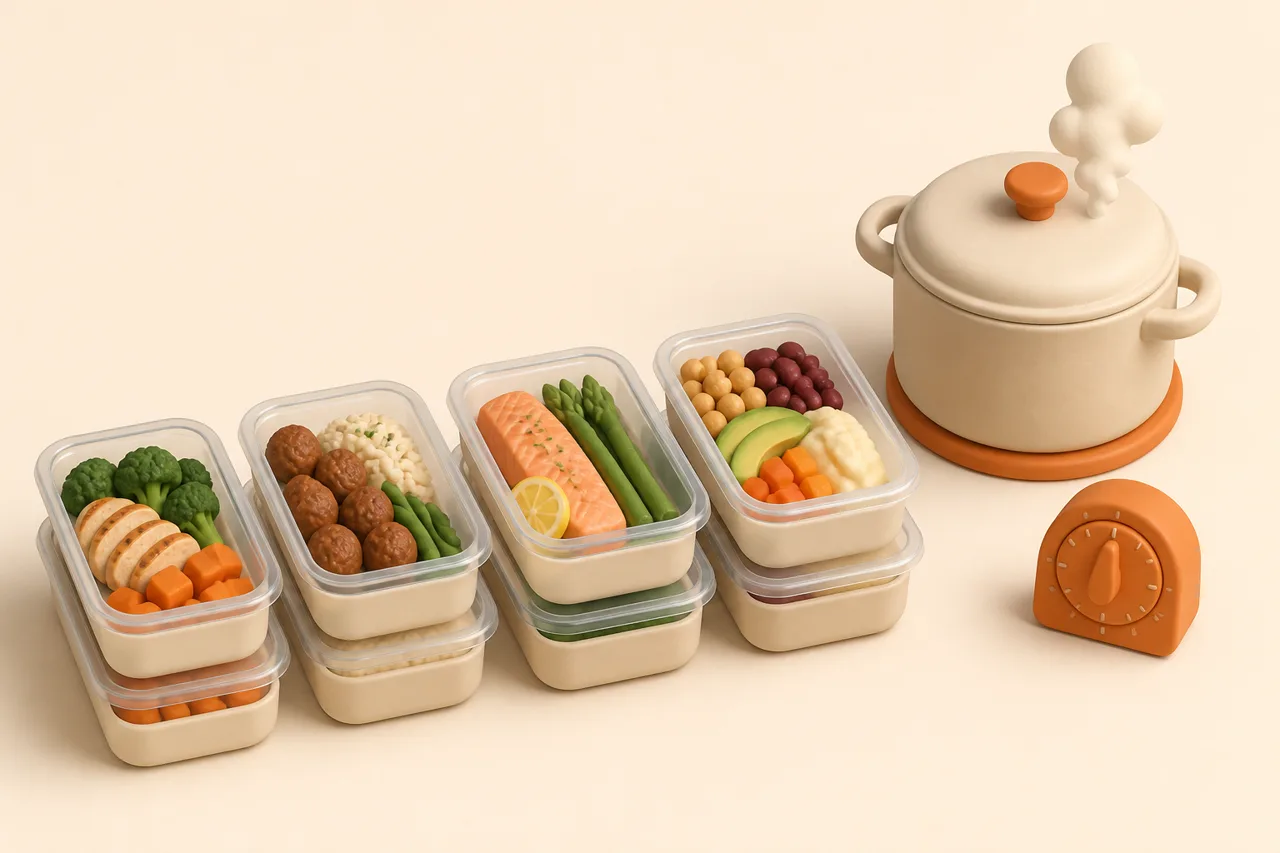
Batch cooking collapses when Sunday produces 5 identical containers. Cook components instead, run the oven, hob and counter in parallel, and finish 3 hours later with parts that combine 9 ways.
Batch cooking fails for a dull reason. You cook 5 finished dinners on Sunday, eat two of them happily, and by Wednesday you cannot face the fourth identical box. Volume was never the problem, repetition was.
This guide covers the component method, an ordering rule for running the oven, hob and counter at the same time, and a 3-hour timetable you can run this weekend. You finish with parts that build 8 or 9 different plates rather than 5 copies of one.
What is batch cooking?
Batch cooking is cooking large quantities of a few base components in one session so that weeknight meals become assembly rather than cooking. It is a production run, not a menu: you make inputs on Sunday and decide the actual dinners during the week.
That is what separates it from meal prep, which usually means portioning finished dishes into containers on day one. Both buy back weeknight time. Component batching costs the same 3 hours and produces far more combinations, which decides whether you are still eating the food on Thursday.
Why cook components instead of 5 finished meals?
Components survive the week because they can change character. A tray of roast squash becomes a grain bowl on Monday, a blitzed soup on Tuesday and a taco filling on Thursday, while a portioned squash curry stays a squash curry until it goes in the bin.
Aim for 8 containers across 4 categories rather than 5 dinners. Each category does a different job on the plate, and the combinations multiply instead of adding up.
- 2 proteins. One roasted or braised, one cold-ready. Shredded chicken thighs plus a pot of spiced chickpeas.
- 2 starches. One grain you can eat cold, one you will reheat. Cooked farro and a tray of roast potatoes.
- 2 vegetable trays. One roasted, one raw and dressed only at the plate so it does not go limp by Tuesday.
- 2 sauces. A herby yoghurt and a chilli oil or vinaigrette. Sauce is what stops the fourth meal tasting like the first.
Pick the components off recipes you already cook rather than shopping for a new set. The selection step belongs in your weekly routine, covered in meal plan for a week.
How do you run the oven, hob and counter together?
Load the oven first, because it is the slowest station and the hardest to change mid-cycle. Every other decision schedules around whatever is roasting.
Think of your kitchen as 3 stations with different attention costs. The oven and the hob run mostly unattended once loaded, so your hands belong at the counter for the middle hour of the session.
| Station | What it owns | Typical run | Your attention |
|---|---|---|---|
| Oven | 2 vegetable trays, a tray of chicken thighs, roast potatoes | 35–55 minutes per load, 2 loads | Load, set a timer, walk away |
| Hob | 1 grain, 1 pot of beans or lentils, 1 pan of onions | 20–40 minutes | A stir every 10 minutes |
| Counter | Sauces, dressings, chopping the second oven load, portioning | Continuous | Constant, so protect this time |
One rule keeps this from unravelling: never chop for a station that is already free. Prep the second oven tray while the first is in, or you will stand at an empty oven with a bag of carrots.
What does a 3-hour session look like?
Three hours is enough for 8 components if you start with the oven and finish with the labelling. Set a timer at each block boundary and move on, even if the sauce is not finished.
- 10:00–0:20 Preheat and first oven load
Oven to 200C while you halve and oil the sturdiest vegetables: squash, carrots, potatoes, cauliflower. Two trays in. Put the grain on the hob with a timer.
- 20:20–0:50 Protein prep and the counter run
Season the chicken thighs or marinate the tofu for load 2. Drain and cool the grain on a wide tray rather than leaving it in the pot, where it steams itself to mush.
- 30:50–1:20 Swap the oven, start the pot
First trays out, protein in. Beans or lentils go on the hob with aromatics. This is the only moment both stations change at once, so do nothing else during it.
- 41:20–1:50 Sauces and raw components
Blitz a herb yoghurt, whisk a vinaigrette, slice the raw slaw and keep the dressing separate. Two sauces take 12 minutes and carry the whole week.
- 51:50–2:20 Cool everything spread out
Nothing goes in the fridge hot. Spread hot components across trays in a single layer so they drop below room temperature fast rather than warming your fridge.
- 62:20–3:00 Portion, label, plan the plates
Container, date, contents. Then write down 4 plate combinations on the lid list so Tuesday you are reading, not deciding.
Which foods reheat well and which do not?
Anything braised, stewed or starchy reheats well; anything crisp, delicate or already dressed does not. The dividing line is moisture, because reheating either dries food out or steams the texture off it.
| Component | Day 4 verdict | How to bring it back |
|---|---|---|
| Braises, chilli, curry, ragu | Better than day 1 | Low heat with a splash of water, lid on |
| Cooked grains and pulses | Reliable | Steam or microwave with a tablespoon of water |
| Roast root vegetables | Good, texture softens | Hot oven or a dry pan for 6 minutes, never the microwave |
| Roast chicken thighs | Good if left on the bone | Covered, 160C, 12 minutes |
| Fish, prawns, fried food | Poor | Cook fresh on the night instead |
| Dressed salad and leafy greens | Poor by day 2 | Store leaves and dressing apart, combine at the plate |
| Pasta boiled and sauced | Poor | Batch the sauce only, boil the pasta on the night |
The pasta row is the one that changes most people's session. Batching sauce and boiling 100g of dry pasta on a Wednesday costs 11 minutes and tastes like cooking, which matters more than it sounds by mid-week.
How do you cool and store batches safely?
Get cooked food from hot to chilled inside 2 hours, and eat refrigerated batches within 3 to 4 days. The risk window sits between roughly 8C and 60C, so the goal is spending as little time in it as possible.
- Spread, do not stack. A 6cm-deep tub of hot chilli takes hours to cool through. The same chilli in 2 shallow containers takes about 40 minutes.
- Label with the cook date, not the eat-by guess. You will not remember on Thursday whether the rice is from Sunday or last Sunday.
- Freeze by Wednesday. Anything unclaimed halfway through the week goes to the freezer while it is still good, not after you notice it is not.
- Reheat once, to steaming. Portion from the batch container and reheat only what you are eating, so the rest never cycles through warm.
- Cooked rice is the strict one. Cool it fast, refrigerate within an hour, and do not push it past the third day.
How do you batch cook with ReciBites?
ReciBites handles the arithmetic and the shopping around the session, so your 3 hours stay in the kitchen. The app plans the week, scales each recipe and merges everything into one list.
- 1Save the recipes you batch from TikTok, Instagram, YouTube, Pinterest, any website URL, or a photo of a cookbook page.
- 2Generate a weekly meal plan, then swap in the components you want to cook in a single session.
- 3Scale each recipe to the total servings you are producing, not the servings the creator wrote.
- 4Send the plan to a grocery list: duplicate ingredients merge into one line, grouped by supermarket aisle.
- 5Ask the cooking assistant to adapt a component for a dietary need, such as gluten-free or halal, before you shop rather than after.
Scaling before the list is generated is the step people skip. Tripling a recipe in your head and then shopping from the original quantities is the single most common reason a session runs short. Cost per portion is worth checking too, as set out in meal prep on a budget.
What goes wrong in a batch cooking session?
Sessions fail on logistics rather than cooking skill. Four habits separate a 3-hour session from a 5-hour one that ends with a sink full of pans.
Session habits
Pros
- Oven loaded within the first 20 minutes
- Second load prepped while the first roasts
- Sauces made last, stored separately from the components
- Everything cooled spread out, then labelled with a date
Cons
- Cooking 5 finished dinners you will be bored of by Wednesday
- Dressing salads and saucing pasta on Sunday
- Sealing hot food into deep tubs and stacking them warm
- Starting without checking you have 8 containers with lids
If you are batching for training or a protein target, the component split changes: proteins scale up and the grains go on the side. That version is covered in high-protein meal prep.
Tool choice matters less than the timetable, but a planner that scales recipes and holds a session plan helps. A drag-and-drop weekly board is compared in ReciBites and Plan to Eat, and an offline-first recipe manager with strong scaling in ReciBites and Paprika.
- Component
- A cooked part of a meal, such as a grain, a protein or a sauce, stored separately and combined into different plates during the week.
- Station
- One heat source or work surface treated as a separate resource with its own queue: oven, hob or counter.
- Shallow cooling
- Spreading hot food into wide, shallow containers so it drops out of the risk temperature range within 2 hours.
Frequently asked questions
+How do I batch cook for a whole week?
Cook 8 components in one 3-hour session: 2 proteins, 2 starches, 2 vegetable trays and 2 sauces. Combine them differently each night instead of portioning 5 finished dinners.
+How long does batch cooking take?
About 3 hours for 8 components, including cooling and portioning. Load the oven in the first 20 minutes so the slowest station is never idle.
+How long does batch cooked food last in the fridge?
Three to 4 days for most cooked components, stored at or below 5C. Cooked rice is stricter: cool it fast and eat it within 3 days.
+What foods should I not batch cook?
Fish, fried food, dressed salads and boiled pasta. Batch the sauce instead and cook the pasta fresh, which takes about 11 minutes on the night.
+Can I put hot food straight into the fridge?
No. Spread it across shallow trays first so it cools within 2 hours. Sealing hot food into deep tubs keeps the centre warm and raises your fridge temperature.
+What is the difference between batch cooking and meal prep?
Meal prep portions finished dinners on day one. Batch cooking makes reusable components, so the same 3 hours produces more variety and holds up later in the week.
+How much food should I batch cook at once?
Enough for 4 or 5 dinners, not 7. Scale each recipe to your real serving count before shopping, and freeze anything unclaimed by Wednesday.
+Can an app plan a batch cooking session?
Yes. ReciBites generates a weekly plan, scales each recipe to your serving count and builds one grocery list that merges duplicates and groups by aisle.
- #batch cooking
- #meal prep
- #food storage
- #weekly plan