

Special Diets and Fitness
How accurate are photo calorie apps, and when do they fail?
A camera cannot see the oil, the sugar in the sauce or what is underneath. Here is where photo estimates hold up, where they drift, and what to do instead.
Photographing a meal to get its calories is the least tedious way to keep a food diary, and that matters, because the reason most diaries get abandoned is effort rather than intent.
The question is what the number is worth. This article sets out where photo estimation is reliable, the 5 systematic gaps, and the cases where a firmer figure is available for less work than you would expect.
What does a photo calorie app actually estimate?
It identifies the foods it can see, guesses their portion sizes from the image, and looks up nutrition figures for each. The output is the sum of several estimates, each carrying its own error.
Two of those 3 steps are hard. Identification is largely solved for common foods, and portion estimation from a flat image is not, because depth has to be inferred. Nutrition lookup then assumes a generic version of the food, which may or may not resemble what you ate.
The result is a figure that is usefully close for some meals and substantially out for others, and the pattern of which is which is predictable enough to work with.
What can a camera not see?
Five things, and they are consistent across every app using this method, because they are properties of photographing food rather than flaws in a particular product.
- 1Cooking fat. A tablespoon of oil is roughly 120 calories and leaves no visible trace. Two tablespoons across a pan for 2 people is 120 per portion, invisible.
- 2Sugar and fat in sauces. A glossy sauce could be reduced stock or double cream, and they differ by several hundred calories.
- 3Portion depth. From above, 150 g of rice and 250 g of rice look nearly identical.
- 4Anything buried. A bake or a curry shows only its surface, so the cheese under the top layer is a guess.
- 5Which version it was. Full-fat or reduced-fat yoghurt, thigh or breast, white or wholemeal, all look similar and differ materially.
Cooking fat is the largest single source of drift, and it goes in one direction: estimates come out low. That matters more than random error, because a consistent underestimate makes a week look better than it was.
Which meals estimate well?
Separation is the variable. A plate where each component is visible and identifiable estimates well; anything mixed, layered or sauced does not.
| Meal | Estimate quality | Why |
|---|---|---|
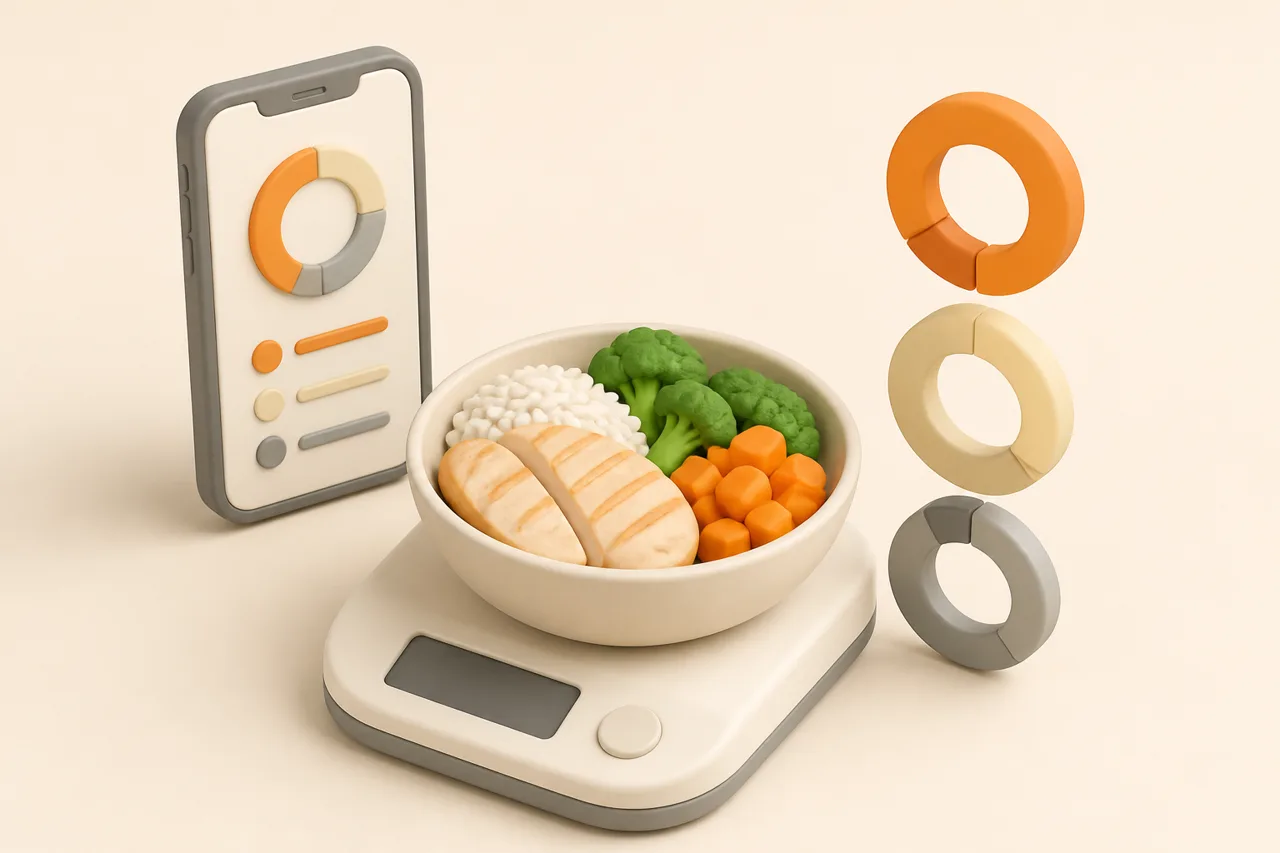
| Grilled chicken, rice, broccoli | Good | Everything visible and separate |
| Greek yoghurt with berries | Good | Two items, though fat content is a guess |
| Sandwich | Moderate | Butter and spread are hidden |
| Stir-fry | Moderate | Oil and sauce sugar invisible |
| Curry with rice | Poor | Coconut milk, oil and depth all inferred |
| Pasta bake | Poor | Only the top layer is visible |
| Homemade cake | Poor | Butter and sugar ratios unknowable from a photo |
Baking is the extreme case and worth flagging separately. A slice of cake could plausibly be anywhere within a range of several hundred calories depending on the butter and sugar in the batter, and none of that is visible in the finished slice.
How do you get firmer numbers?
For anything you cooked yourself, take the numbers from the recipe. It sounds like more work and is usually less, because a recipe is a measurement that already happened.
Total the ingredients once, divide by the yield, and you have a per-serving figure you can reuse every time you cook that dish. Cook 15 dinners on rotation and 15 calculations cover most of your year, which is the approach in calculate calories in a recipe.
- Weigh the fat you add. It is the ingredient most often left out and the one that moves the number most.
- Record the yield honestly. A recipe that says 4 servings and feeds 3 is a 33% error on every portion.
- Keep the figure with the recipe so you calculate once rather than every time.
- Use a database or barcode for restaurant and packaged food, where no recipe exists.
How wrong can an estimate be in practice?
Worth putting numbers on, because the abstract answer of approximate does not help you decide whether to trust one.
Take a homemade chicken curry with rice, a fair test since it is a common weeknight dinner and a hard case for a camera. The visible components are chicken, sauce and rice. The invisible ones are 2 tablespoons of oil used to fry the base, 400 ml of coconut milk in a pan serving 4, and however much rice is actually under the sauce.
| Component | What a photo can judge | Range it introduces |
|---|---|---|
| Chicken | Reasonably well if visible | Small, mostly thigh against breast |
| Rice | Surface area, not depth | Moderate, 150 g against 250 g |
| Frying oil | Nothing at all | Around 60 calories per portion |
| Coconut milk | Colour only | Large, full-fat against light |
| Total | An underestimate | Consistently low, not randomly wrong |
For a dinner like that, a photo estimate landing 15% to 25% below the real figure would not be surprising. If you are eating to a maintenance level and want a rough sense of the week, that is tolerable. If you are working to a deficit that depends on the numbers, it is the difference between progress and confusion.
When is a photo estimate the right tool?
More often than the accuracy discussion suggests. A rough number you capture beats a precise one you abandon after 5 days, and consistency matters more than precision for spotting a trend.
It is the right tool when you eat a lot of food you did not cook, when you want a directional sense of a week rather than an audit, or when you have tried database logging before and stopped. It is the wrong tool when a specific target has to be hit, since a consistent underestimate on cooking fat is exactly the error a target cannot absorb.
The stronger move for most people is upstream: decide the week's meals in advance, so the food is already appropriate and the measurement is a check rather than a verdict. Meal plan for weight loss covers that side, and track macros in recipes covers getting numbers without a full diary.
It is also worth knowing that the estimate is not the only number carrying uncertainty. Nutrition figures for the same food vary between databases, portion sizes vary between people, and a recipe cooked twice is never quite identical. Nobody is working with exact figures, which argues for treating any single day as noise and any consistent 2-week direction as information.
On apps, ReciBites vs Cal AI covers photo estimation directly and ReciBites vs MyFitnessPal covers database logging.
- Portion estimation
- Inferring how much food is present from an image. The largest source of error, because depth is not visible from above.
- Systematic error
- An error that leans consistently one way, such as omitting cooking oil, which makes a week look better than it was.
- Per-serving figure
- The nutrition of one portion, calculated by totalling a recipe's ingredients and dividing by its yield.
Frequently asked questions
+How accurate are photo calorie apps?
Good enough for a trend, weak as a precise figure. Simple separated plates estimate well; curries, bakes and anything sauced come out low.
+What does a camera miss most often?
Cooking oil, sugar and fat in sauces, portion depth, anything buried under a surface layer, and which version of a food it was.
+How much does cooking oil change the number?
A tablespoon is around 120 calories. Two tablespoons split between 2 portions adds roughly 120 each, and none of it is visible.
+Which meals estimate worst?
Curries, pasta bakes and homemade cake. The cooking process hid the fat and sugar, so only the surface is available to the camera.
+Is a recipe more accurate than a photo?
For food you cooked, yes. The quantities were decided before cooking, so totalling the ingredients and dividing by the yield gives a firmer figure.
+Should I use a photo app at all?
Yes, if the alternative is recording nothing, or if you eat mostly food you did not cook. A captured rough number beats an abandoned precise one.
+Do photo apps improve with better photos?
Somewhat. Shooting at an angle rather than straight down helps portion depth, and photographing before mixing helps identification.
+What is better than tracking for hitting a target?
Planning the week in advance, so the meals are already appropriate. Then measurement becomes a check rather than a verdict after the fact.
- #nutrition
- #ai
- #tracking
- #calories