

Special Diets and Fitness
How to track macros in recipes you actually cook
Packaged food tracks itself. A pot of chilli that fed 4 people unevenly does not, and that is the meal most people give up logging.
Tracking a protein bar takes 4 seconds. Tracking the chilli you made on Sunday, portioned unevenly into 5 containers, is the thing that makes people quit after a fortnight.
Home-cooked food is the hard case because the numbers on the packet describe raw ingredients while you eat a cooked mixture. This guide covers a workflow that survives real cooking, and the accuracy threshold that is genuinely good enough.
What is macro tracking for home-cooked food?
Macro tracking is recording the protein, carbohydrate and fat you eat, usually in grams, against a daily target. For home-cooked food it means deriving those numbers for a dish you invented, rather than reading them off a label.
The derivation has two halves: totalling the macros of everything that went into the pot, and working out what fraction of that pot ended up on your plate. Most tracking failures are the second half, not the first.
Why is home-cooked food harder to track than packaged food?
Home cooking loses the two things a label gives you for free: a fixed recipe and a fixed portion. Every batch differs slightly, and nobody serves themselves exactly one fifth of a tray.
- The recipe drifts. An extra glug of oil is 120 calories and 14 g of fat that never reaches your log.
- Weight changes during cooking. Water evaporates, fat renders out, grains absorb. The pot weighs less than its ingredients did.
- Portions are eyeballed. Serving 4 people from one pan produces portions that vary by 30 percent or more.
- Database entries disagree. Three entries for
chicken thighwill give three different numbers, and one of them will be wrong.
Oil is the single biggest source of silent error, because it is invisible in the finished dish and dense in calories. Measure it with a spoon rather than pouring, at least until you can estimate it reliably.
Should you track per recipe or per portion?
Track per recipe once, then derive per portion every time you eat it. Recipe-level totals stay valid for as long as you cook it the same way, while portion-level numbers change with every serving.
| Approach | Effort | Accuracy | Use it when |
|---|---|---|---|
| Log each ingredient at the table | High, every meal | Good, if you remember everything | One-off meals you will never repeat |
| Recipe total divided by stated servings | Low, once per recipe | Rough, because servings are uneven | Portions you plate identically, like burgers |
| Recipe total divided by cooked grams | Medium, once per recipe | Best available at home | Anything from a pot, tray or pan |
| Guessing from a similar restaurant dish | None | Poor, usually understated | Days you are not really tracking |
How do you weigh a finished dish and divide it?
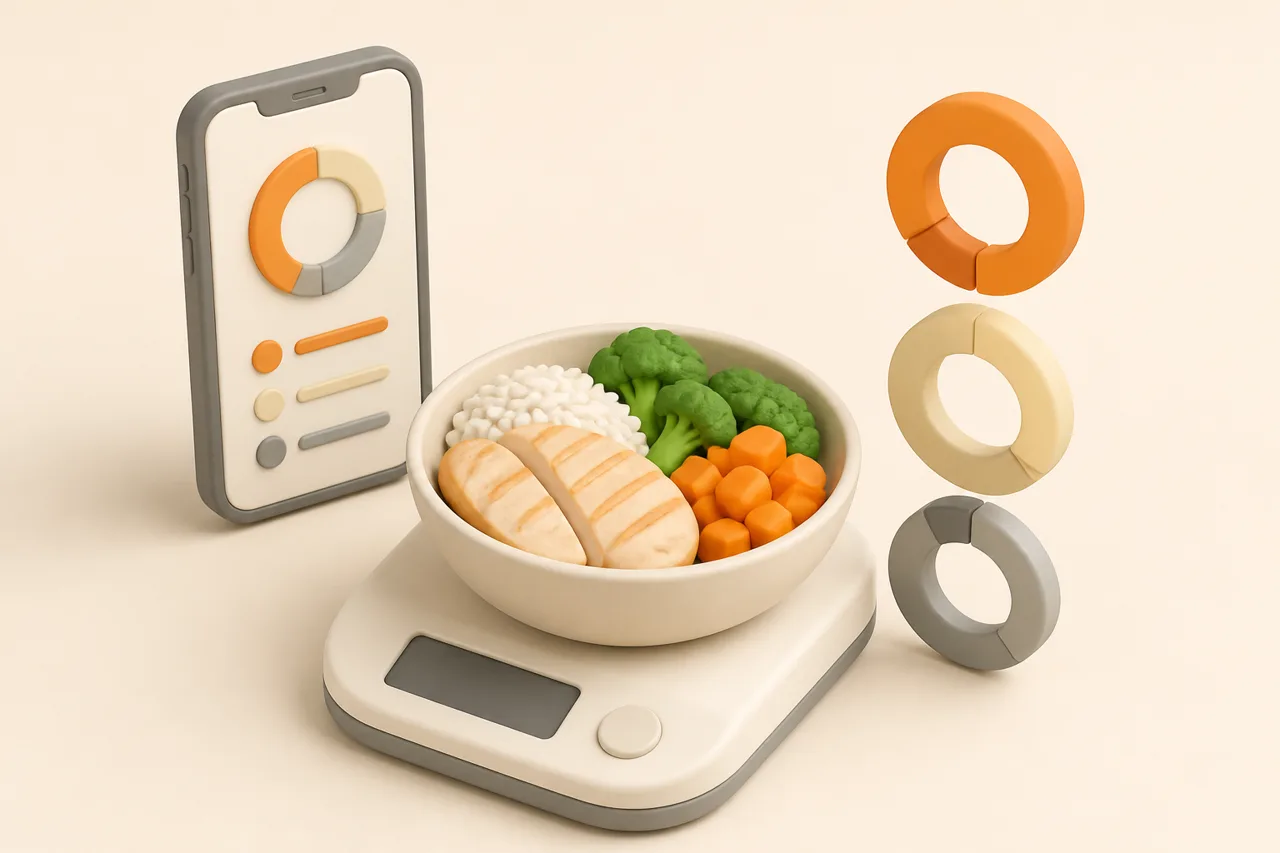
Log the ingredients raw, weigh the cooked dish, and divide to get macros per gram. Water loss stops mattering, because whatever evaporated was never a macro in the first place.
- 1Weigh the empty pot
Do this before you start. Note the number, or leave the pot on the scale and use the tare function as you add ingredients.
- 2Log every ingredient at raw weight
Use the raw entry from your tracker's database. Include the oil, the butter in the pan and anything you added at the end.
- 3Weigh the finished dish
Put the whole pot back on the scale after cooking and subtract the pot's weight. Say the food comes to 1,850 g.
- 4Divide the totals by the grams
If the pot holds 148 g of protein and 1,850 g of food, that is 0.08 g of protein per gram. Do the same for carbohydrate and fat.
- 5Weigh your actual serving
A 400 g plate is 32 g of protein. Log that, and the leftovers stay correct however unevenly the rest gets divided.
Save the per-gram figures into the recipe notes and the setup cost disappears on every future batch. Scaling the recipe up changes nothing about the per-gram numbers, which is a useful property covered in scaling recipe servings.
Why do raw and cooked weights disagree?
Raw and cooked weights disagree because cooking mostly moves water, and water carries no macros. A chicken breast that loses 25 percent of its weight in the oven has the same protein it started with, concentrated into less mass.
| Ingredient | Weight change when cooked | Approximate protein per 100 g cooked |
|---|---|---|
| Chicken breast | Loses roughly 25 percent | About 31 g |
| Beef mince, 5 percent fat | Loses roughly 25 percent, plus rendered fat | About 26 g |
| Salmon fillet | Loses roughly 20 percent | About 25 g |
| White rice | Gains roughly 150 to 200 percent | About 3 g |
| Dried pasta | Gains roughly 120 percent | About 5 g |
| Dried lentils | Gains roughly 130 percent | About 9 g |
Cooked-weight logging drifts because that percentage is not a constant. The same breast loses 18 percent poached and 32 percent under a grill, so a cooked-weight entry silently under-reports on some days and over-reports on others. Logging raw removes the variable entirely.
When is 90 percent accuracy enough?
For general body composition goals, consistent tracking within about 10 percent beats exact tracking you abandon. Precision has a cost in effort, and the effort budget is what actually runs out.
| Goal | Precision needed | What to weigh |
|---|---|---|
| General health and habit building | Loose, roughly 20 percent | Protein sources only |
| Fat loss or a lean gain | Around 10 percent | Protein, fats and calorie-dense extras |
| Hitting a protein floor | Around 10 percent, one macro | Protein sources, ignore the rest |
| Competition or clinical protocol | Tight, under 5 percent | Everything, every time, raw |
Most people sit in the middle two rows and behave as though they are in the last one. Weigh the oil and the protein, estimate the vegetables, and you capture roughly 90 percent of the variance for a fraction of the work. The same logic applies to meal planning for weight loss.
How do a recipe organiser and a tracker work together?
They do different jobs, and pretending one does both is how people end up with two half-maintained systems. A tracker owns the numbers; a recipe organiser owns the recipes, the plan and the shopping.
In practice the split works like this: ReciBites holds the recipe, its notes, the per-gram figures you worked out and the week's plan. Your tracker holds the daily log. The recipe notes field is the bridge, because it survives every time you cook the dish again.
- 1Import the recipe once, from a video, a website or a photo of a cookbook page.
- 2Run the weigh-and-divide method the first time you cook it, then paste the per-gram numbers into the notes.
- 3Add the recipe to your weekly plan and let the grocery list build from it.
- 4Log the portion weight in your tracker, using the saved figures.
If you would rather your recipe app carried nutrition estimates itself, that is a real reason to choose differently, and ReciBites vs Samsung Food and ReciBites vs BigOven are the honest starting points. For working out the calorie side by hand, see calculating calories in a recipe.
Which habits cause macro drift?
Drift comes from a small set of repeated omissions rather than from bad arithmetic. Each one is worth 50 to 200 calories a day, which is enough to stall progress while the log looks perfect.
Habits that keep a log honest
Pros
- Weigh oil and butter with a spoon or on the scale rather than pouring
- Log raw weights and keep one trusted database entry per ingredient
- Store the per-gram figures in the recipe so the second cook is instant
- Weigh your own portion instead of dividing by stated servings
Cons
- Logging cooked weights against raw database entries
- Ignoring cooking fat because it is invisible in the finished dish
- Counting a tray as 4 equal portions when it was never divided equally
- Rebuilding the numbers from scratch every time you cook the same recipe
Batch cooking makes all of this easier, because one weighing session covers 5 meals. The workflow pairs well with high-protein meal prep if you are chasing a protein target specifically.
If you are deciding between this and a food diary, recipe app vs calorie tracker covers which half of your week each one actually fixes.
- Macros
- Protein, carbohydrate and fat, measured in grams. Alcohol is a fourth energy source that most trackers handle separately.
- Per-gram macros
- A dish's total macros divided by the cooked weight of the whole dish, so any portion can be logged by weighing it.
- Yield loss
- The weight a dish loses during cooking, almost all of it water and rendered fat rather than protein or carbohydrate.
- Tare
- Zeroing a scale with a container on it, so the reading shows only what you add next.
Frequently asked questions
+How do I calculate macros for a recipe I made up?
Log every ingredient at raw weight, weigh the whole cooked dish, then divide the totals by the cooked grams. Multiply by your portion weight to log it.
+Should I weigh food raw or cooked?
Raw, because databases list raw values and cooking loss varies with the pan and the heat. Cooked-weight logging drifts differently from batch to batch.
+How do I track macros for a dish that serves 4 unevenly?
Work out macros per gram of the finished dish, then weigh your own plate. Uneven portions stop mattering because each one is logged by weight.
+Does ReciBites calculate calories or macros?
No. ReciBites has no nutrition database and no macro calculation. It stores, adapts and plans recipes, and the numbers come from a separate tracking app.
+How accurate does macro tracking need to be?
For most goals, staying within about 10 percent consistently works better than perfect logging you abandon. Weigh protein and fats, estimate the vegetables.
+How much protein is in cooked chicken breast?
Roughly 31 g per 100 g cooked, up from about 23 g per 100 g raw. The protein does not change; water loss concentrates it.
+Do I need to log cooking oil?
Yes. A tablespoon is around 120 calories and 14 g of fat, and it disappears into the dish. Unlogged oil is the most common source of drift.
+Can I reuse macro numbers next time I cook the recipe?
Yes, if you cook it the same way. Save the per-gram figures in the recipe notes and future batches take one weighing and one multiplication.
- #macros
- #nutrition tracking
- #meal prep
- #portioning